July 13, 2026
Long before criminal justice students enter the field, Grand Rapids Community College's CJ 122 Spanish for Criminal Justice, teaches a skill that extends beyond law enforcement: understanding the people they will serve.
The course is a prerequisite for the Grand Rapids Police Academy and introduces students to law enforcement vocabulary, cultural awareness and communication skills. While it fulfills an Academy requirement, its broader mission is to help students develop the empathy and perspective needed to communicate effectively with people from diverse backgrounds.
Adjunct instructor and Grand Rapids Police Department West Service Area Commander Capt. Greg Alcala said those lessons are just as important as learning policing fundamentals.
"GRCC is very forward-thinking in providing this class as a prerequisite for the Police Academy," Alcala said. "We need to teach students the nuts and bolts of the profession, but we also need to teach them how culture and community come together. We want them to recognize where communication barriers — verbal and nonverbal — can exist and learn how to address them before they're in the field. CJ 122 does exactly that."
Learning Beyond the Textbook
Students enter the class with different goals. Some plan to become police officers, while others are pursuing careers in criminal justice, social work or other public-service fields serving predominantly Spanish-speaking communities.
To connect with every student, instructors tie lessons directly to real-world situations. Rather than teaching vocabulary in isolation, they explain how language and cultural awareness influence interactions between officers and community members.
Instructor Jamie Vazquez, who has taught the course for 15 years, uses Total Physical Response, or TPR, to reinforce learning. The teaching method pairs Spanish commands with physical movement to improve memory and recall.
"You put motion to the words, and it helps your brain recall them," Vazquez said. "Commands like 'hands up,' 'hands down,' 'spread your feet,' 'hands on your head' and 'hands behind your back' become easier to remember because students physically practice them every week. I've had former students tell me years later they still remember those phrases."
Because of the hands-on approach, students do not need prior Spanish experience to succeed.
Seeing the Person Behind the Situation
Beyond vocabulary, the course emphasizes understanding the people students may encounter on the job rather than relying on stereotypes.
Drawing from her experience working with migrant communities, Vazquez introduces students to cultural differences that can shape communication. Lessons explore topics such as family dynamics, naming traditions and personal interaction styles, helping students recognize that communication barriers often extend beyond language.
"We're all just human beings," Vazquez said. "Many of the people these students will meet are here to work and take care of their families. Understanding someone's culture, background and communication style brings humanity to the interaction."
She said that understanding can also help de-escalate tense situations.
"For many Spanish speakers, conversation is personal before it's transactional," Vazquez said. "Taking a moment to establish that connection can reduce fear and confusion, especially for someone who doesn't speak English and may not understand what's happening."
Building Perspective Before the Academy
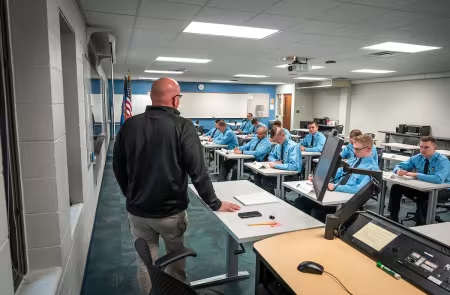
Alcala also challenges students to examine the social factors that shape communities.
One lesson explores gang culture in agricultural communities in California, where poverty, limited opportunities and social marginalization can influence gang involvement. The goal is not to excuse criminal behavior but to help students understand the circumstances that can shape people's lives.
"Understanding those factors helps future officers approach situations with greater awareness while maintaining accountability and professionalism," Alcala said. "It helps students see there are multiple sides to every situation."
Presenting those discussions in the classroom allows students to develop perspective before encountering similar situations in the field. Alcala said that preparation helps future officers communicate more effectively while improving safety for everyone involved.
The course also creates opportunities for learning in both directions. Students pursuing law enforcement gain insight into the communities they may serve, while classmates with little familiarity with policing learn why officers sometimes make difficult decisions under pressure. Conversations about legal responsibilities, public safety and community expectations encourage students to examine issues from multiple perspectives.
Skills That Extend Beyond Law Enforcement
Although CJ 122 is designed to prepare students for the Police Academy, its lessons apply across many professions.
Communication skills, cultural competency and the ability to build trust are valuable in social work, mental health, education, probation services and other public-service careers. Students leave the course with practical tools for communicating across language barriers and navigating cultural differences with respect.
For future police officers, that foundation begins before they ever wear a badge. For others, it prepares them to serve diverse communities with empathy, professionalism and a deeper understanding of the people behind every interaction.
Visit the Criminal Justice department web page to learn more about programs and areas of study.
This story was reported by Anjula Caldwell.