Feb. 6, 2026
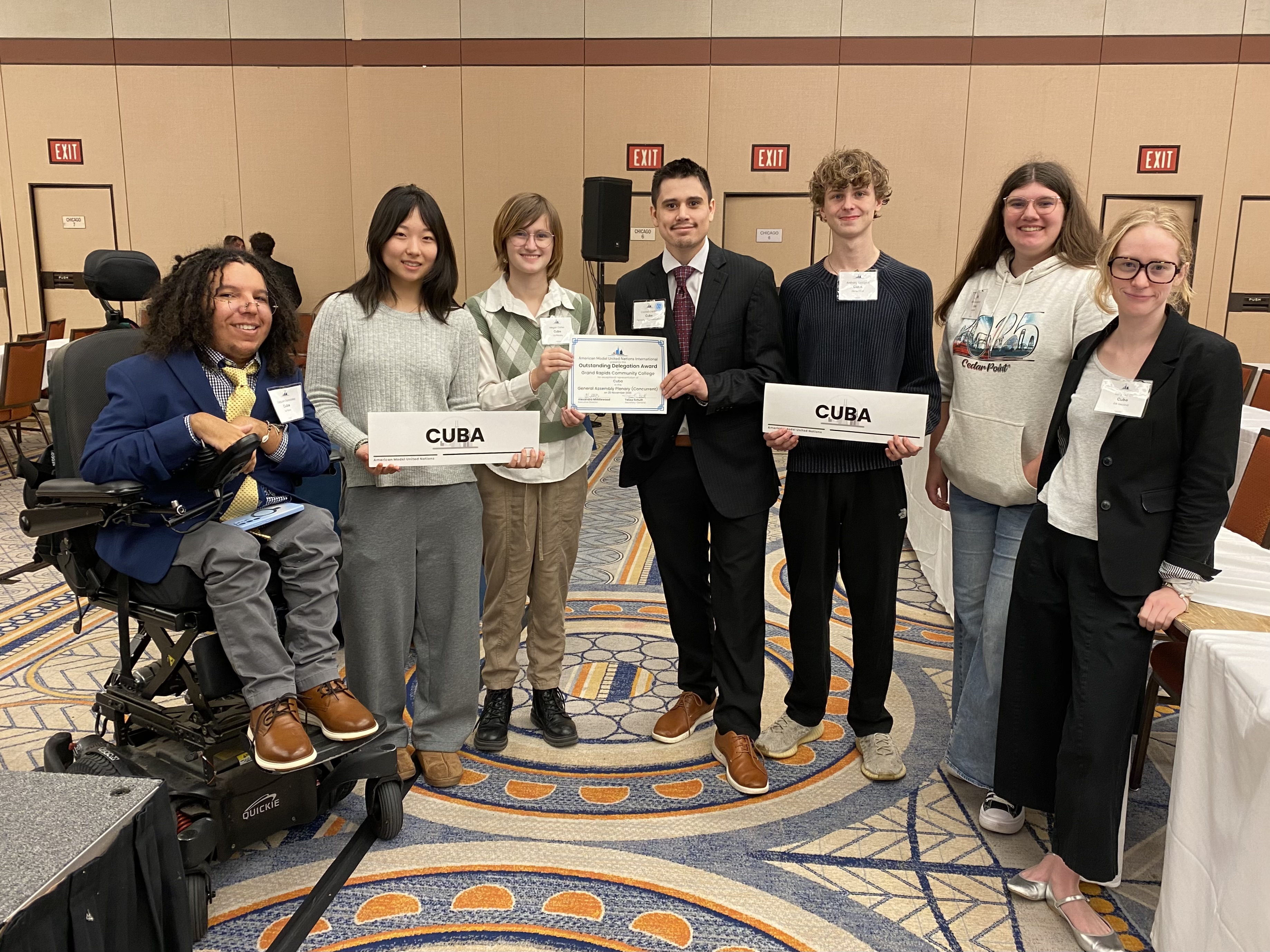
During the American Model United Nations (AMUN) conference in Chicago this past fall, the Grand Rapids Community College’s Foreign Affairs Club earned one of the most prestigious awards in its more than 20-year history at GRCC.
The team received the Outstanding Delegation award for its representation of Cuba at the General Assembly plenary meeting. Since first attending the conference in 2003, this is the highest honor GRCC students have earned at AMUN.
The Foreign Affairs Club is a student organization focused on Model United Nations, giving students opportunities to explore global politics, economics, culture and diplomacy through research, discussion and participation in conferences. AMUN offers realistic simulations of the United Nations, with teams from universities and community colleges representing countries and their interests.
“The students learn a lot about the country they’re representing as they spend time researching,” said Foreign Affairs Club faculty adviser and Professor Keith St. Clair. “They also learn about the United Nations and how it works. They learn about political issues around the world and how countries work to solve these problems — not on the battlefield, but through negotiation. It really hones negotiation skills and public speaking. The students this year did an amazing job. I’m so proud of them.”
GRCC’s Foreign Affairs Club was one of only a handful of community colleges represented at the conference, making the accomplishment particularly notable.
“Colleges and universities from across the country, and even some outside the United States, come to the conference,” St. Clair said. “There are only a handful of community colleges. We’re going up against four-year students who are often taking it as a class. Our students are doing this as an extracurricular club. I didn’t expect it, but I knew they were prepared. We had some veterans on the team, and it really made a difference this year.”
Seven students traveled to the conference: Megan Carter, Conrad Carrillo, Q Gonzales, Rachel Hyun, Sheridan Llewellyn, Sally Odren and Anthony Sweigart.
This year, the team was responsible for representing Cuba. Throughout the conference, students debated, negotiated and drafted resolutions on major global issues, including humanitarian crises, climate change, international law, decolonization and peace and security.
With many teams dedicating entire semesters to writing resolutions, team member and permanent representative Conrad Carrillo knew he needed to draw on his previous experience.
“This year, I wanted to make sure we put in the effort early on to fundraise and secure our spot as a club,” Carrillo said. “That way, we could get the logistics handled quickly and focus as much time as possible on drafting our resolutions. We only meet once a week, so I knew each meeting needed to count.”
Carrillo, who served as the club’s president in previous years, said his experience helped the team focus on individual strengths while working cohesively.
“We took time each night at the conference to debrief on how things went within our committees,” Carrillo said. “That allowed us to have a good overall perspective of what was happening with the resolutions and other countries. Since we were representing Cuba, the team representing the United States was very interested in what we were saying. It’s one of the perks of participating in something like this. It mimics real-world politics.”
The exchange between Cuba and the United States became contentious as each representative responded to the other’s concerns through written messages (which is standard procedure). As the atmosphere grew more adversarial, the plenary team called a press conference to address concerns made by the United States delegation. Carter and Carrillo remained diplomatic and defended Cuba’s needs.
“A lot of countries cared about how the United States was responding to our resolution, so we called a press conference,” Carrillo said. “That opened the door for us to be noticed since there were a lot of eyes on the situation. We were focused on achieving our diplomatic goals.”
Carrillo and his plenary committee partner, Megan Carter, helped the GRCC delegation gain recognition among their peers. Despite being one of the few community colleges represented — and operating as a volunteer club that meets once a week — the team made a strong impression through its conduct when faced with opposition from the United States.
“I’m really proud of these students,” St. Clair said. “They did it all. This wasn’t a class I was grading or an assignment they were turning in. This is a voluntary club, and they put the work in. Not only did it show during the conference, but their peers voted for them to win an incredible award.”
Carrillo said the Foreign Affairs Club played an important role helping him feel connected during his time at GRCC.
“Being part of the club led me to get to know the student body more thoroughly,” he said. “I attended town hall meetings and got to know student life better. I’m still friends with people I met during my first year after joining the club. We built a community with people who have similar interests. I transferred to the University of Michigan, where I am now, and I will always value my time at GRCC and what we were able to accomplish as a club at the American Model UN conference.”
Learn more about the American Model United Nations. To learn more about the Foreign Affairs Club and how to join, contact Professor Keith St. Clair at kstclair@grcc.edu
Photo Caption: GRCC’s Foreign Affairs Club at National Model United Nations Conference representing Cuba.
This story was reported by Anjula Caldwell.