Dec. 10, 2025
Community Learning Experience
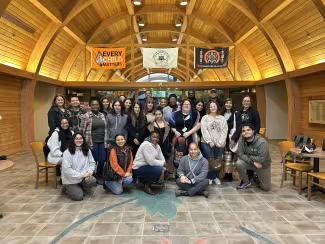
During Native American Heritage Month, a group of Grand Rapids Community College students, faculty and community members stepped into a living archive of Great Lakes Indigenous history. The Cultural Connections 365 Committee partnered with the Bob and Aleicia Woodrick Center for Inclusion and Multicultural Affairs to lead a campus community visit to the Ziibiwing Center in Mount Pleasant, Michigan. Supported by the Transfer Bridges program and the Mellon Foundation’s commitment to high impact learning experiences, the trip invited participants to immerse themselves in the history, culture and living traditions of the Saginaw Chippewa Indian Tribe of Michigan and other Great Lakes Anishinabek peoples.
“We recognize the importance of exposing students to Indigenous studies and the rich history of Indigenous peoples in Michigan,” said Leanne Challa, manager of the Transfer Bridges program. “Experiences like this help students make real connections to stories that are too often overlooked.”
Preserving Michigan’s Indigenous Histories
Michigan is home to 12 federally recognized tribes, each with its own history and cultural identity. Many of these stories are preserved and shared through the Ziibiwing Center, which is dedicated to educating visitors about the resilience and richness of Indigenous communities. The center’s permanent and rotating exhibits highlight both the beauty of Anishinabek culture and the painful realities Native communities have endured, including the legacy of federal boarding schools.
For generations, boarding schools attempted to erase Native languages and cultural practices. Children were removed from their homes, prohibited from speaking their languages and forced to assimilate into Euro-American norms. The Ziibiwing Center’s exhibit on the Mount Pleasant Indian Industrial Boarding School, located only a few miles from the center, shares the history of the tragedy as experienced by the local Anishinabek peoples. The center also hosts an annual Honoring, Healing & Remembering event to acknowledge the children who were taken to the school and those who never returned home.
Cultural Resilience and Innovation
Walking through the center, visitors experience a vibrant portrait of Anishinabek life — a story of endurance rooted in land, language, family and community. Laughter sits at the center of Anishinabek life, reflecting the joy carried in the hearts of the people. Generations have worked hard to keep their culture alive, creating spaces to celebrate its richness and the strength of their resilience.
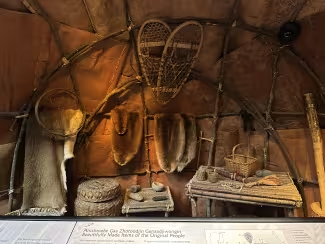
Artifacts throughout the exhibits reveal the engineering skill, artistry and innovation that existed long before modern technology. Tools for hunting and gathering, clothing made from natural materials and early forms of items still used today show how deeply Indigenous creativity has influenced modern life. During a special presentation, the group learned about early versions of baby diapers made from rabbit skin, as well as the origins of instruments such as the drum, which evolved into forms now widely used across musical traditions
For many students, these connections between past and present brought new appreciation for Indigenous contributions to daily life.
“I learned about so many tools we use every day,” said Marcus Harris, a business major at GRCC. “The clothing we wear and how it came about, the drum, and how it eventually created the tambourine — it was all enlightening. I realized how many similarities we have, which was very eye-opening for me. We carry more connections and similarities than differences.”
Learning From Native Voices
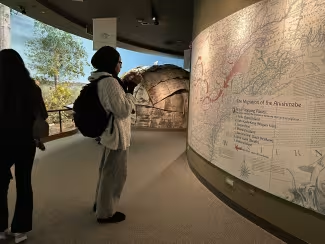
The visit also offered an opportunity for reflection on how stories are passed down and who gets to tell them. One of the goals of the center is to create a space for Indigenous stories to be told by Indigenous people themselves. This commitment is reflected in language revitalization efforts, including youth immersion classes designed to strengthen cultural identity and preserve traditional knowledge.
“It feels very powerful to know the place you’re connected to and your history,” said Ijlal Nuriddin, a student on the waist list for GRCC’s Nursing Program. “As a Black American, I have a discontinued narrative because of the African diaspora. Experiencing each exhibit has helped me see how the Anishinabe people are intentionally getting back who they are.”
Many in the group said they valued the chance to learn history in a space grounded in Native voices.
“I think a lot of the story is untold because of residential schools and the loss of Indigenous culture in general,” said Valerie Clingen, a history major at GRCC. “I hope to learn more and share it with my kids, to bring it to the next generation. I’m also working toward becoming a museum curator or director. Learning about how the culture and reciprocity of the land is important, and it’s something we need to carry forward.”
A 10-minute film about the Anishinabek creation story resonated with Alyssa Gamez, associate director of the Woodrick Center. She noticed parallels with her own religious background.
“The video about the beginning of people as it was given to the Anishinabek was very interesting as a Christian,” said Gamez. “I saw the similarities — the same themes, the same moral foundations. It felt like the same story I grew up hearing. Experiences like this help us see that our cultures often share more common ground than we realize.”
Community, Movement and Reflection
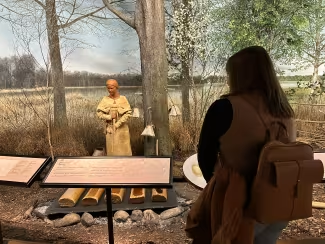
During the visit, the group experienced traditional dance performances by Native dancers, followed by the opportunity to participate in a round dance symbolizing unity and community. The moment offered participants a chance to reflect on the themes of resilience, healing and continuity present throughout the exhibits.
For many, one of the most powerful aspects of the trip was confronting the difficult history of the boarding schools while also witnessing the strength of a community working to preserve and revitalize its culture.
“To actually be in a place where there was a boarding school and learn what it truly represented was a very moving experience for me,” said Tari Mattox, professor and member of the Cultural Connections 365 Committee. “Then to see this beautiful center thriving — promoting the language, sharing the art and passing down the traditions — was incredibly meaningful. They talked about bridging the gap between the generation that was essentially stolen and the younger generations still feeling the impact. It’s my hope that we bring this knowledge back to GRCC and continue these conversations.”
Carrying the Story Forward
The Ziibiwing Center remains committed to keeping these stories alive and ensuring that future generations understand both the tragedies and triumphs that shape Indigenous communities today. The GRCC group returned with a deeper understanding of Michigan’s Indigenous history — and a renewed commitment to honoring and learning from the voices that carry it forward.
To learn more about the Ziibiwing Center visit https://www.sagchip.org/ziibiwing/
This story was reported by Anjula Caldwell.