Jan. 27, 2026
Home technology is a hot trend. Many of us chat with Alexa, protect our front doors with Ring, whisk away daily dirt with robotic vacuums, and much more.
But home technology is more than trendy fun. Dr. Robin Pegg, assistant professor/academic fieldwork coordinator for the Occupational Therapy Assistant (OTA) program at GRCC says that assistive technology can be transformative for people living with disabilities.
“Assistive technology provides people with access to activities of daily living,” Pegg said. “Solutions can be as simple as weighted silverware, or as complex as a home lighting system. Regardless of the complexity, these tools make life easier and richer for those who use them.”
Robin says that OTAs provide the knowledge to identify and apply a vast array of assistive tools. In fact, the accreditation standards for this profession require that students learn about them.
However, we all know that book learning does not always resemble real life. That’s why Robin and her students are delighted to partner with MOKA for practical, hands-on experience.
MOKA was founded in 1978 by a group of parents concerned about the future of their family members diagnosed with intellectual and developmental disabilities. MOKA offers many services, but their group homes have led to a strong tie with GRCC. MOKA has over 40 such homes, where 4-6 individuals live with varying levels of support from direct support professionals. The goal is for each person to live the most empowered and autonomous life possible.
Approximately five years ago, the GRCC OTA Club ran an event for MOKA participants. That connected Robin to Emily Betz, director of programs for MOKA. Emily wanted to incorporate more assistive technology into group homes. Robin, who is a RESNA-certified assistive technology professional, jumped at the chance.
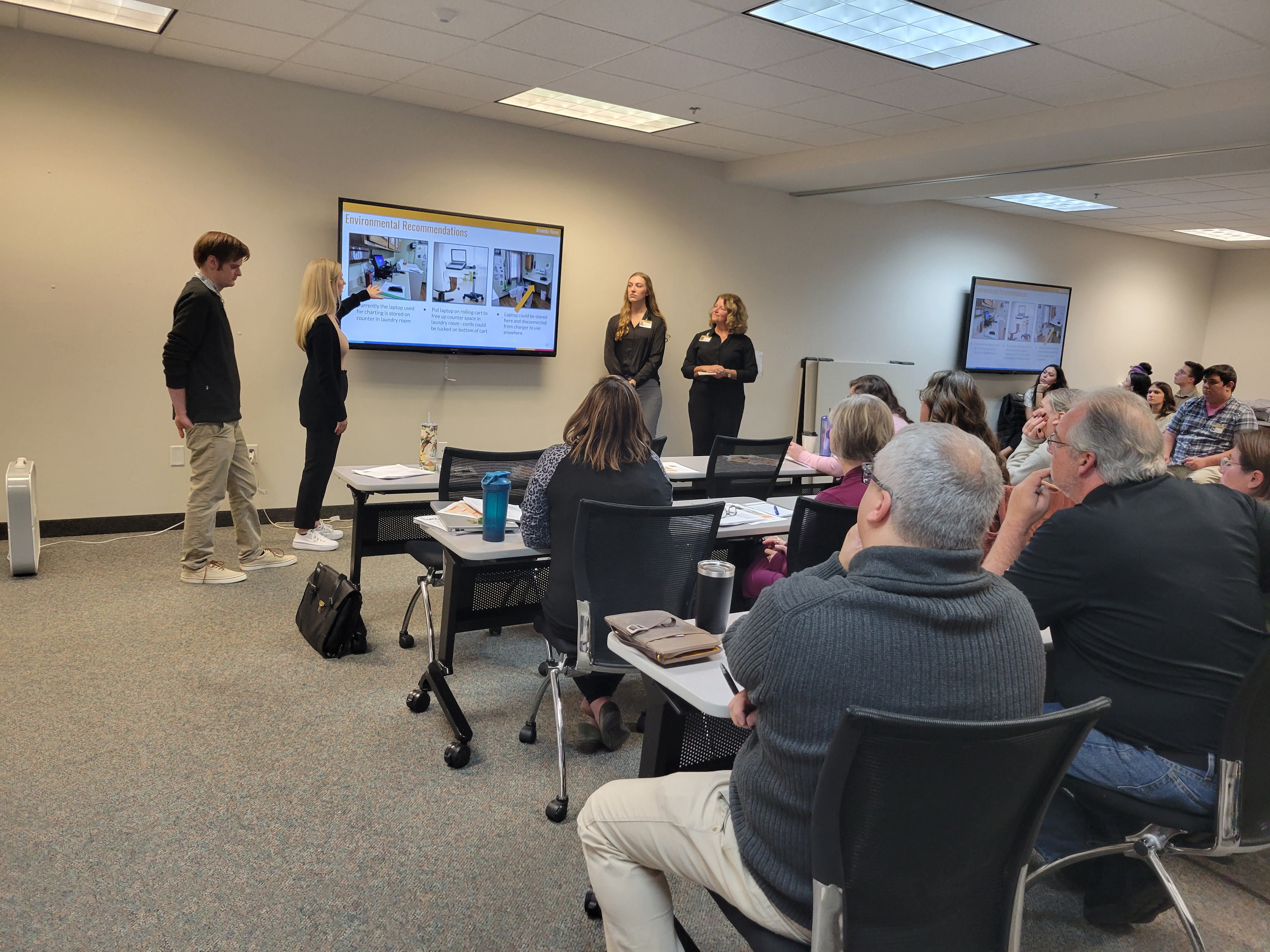
Together, Robin and Emily decided that the students would evaluate two group homes every year. They break into small teams, assess every part of the home, and also evaluate processes. They provide an extensive final presentation and report that includes all recommendations, costs and purchasing links.
"This partnership checks so many boxes for our students and our accreditation," Pegg said. “Students are learning to work in multi-level teams. They are assessing and making recommendations. They are learning about costs and how to find funding. And together, we are collaborating to make the community a richer place for all. Our accrediting agency was blown away when we told them about this relationship."
As for MOKA, this is serious and valuable work.
“We've received hundreds of recommendations over the course of several years,” said Samantha Brigham, director of development for MOKA. “Our team reviews them all. We put the easy, lower cost options in place right away. Others that may be more expensive might influence fundraising activities or future budgets.”
Samantha notes that some of the recommendations can be implemented almost immediately, and the results quickly follow.
“When a recommendation helps a resident gain independence, the mood in the house lightens,” Brigham said. “For example, many residents want to do their own laundry but it’s difficult for them to read the directions. GRCC recommended a simple set of color-coded instructions to bridge that gap.”
Tracey Hamlet, executive director of MOKA, says that the recommendations impact not only the residents, but also the direct care workers who represent the majority of MOKA’s 450 employees.
“MOKA is committed to quality care at every level, which includes care givers,” Hamlet said.
“We know better than most that the quality of the experience improves at every level when our employees aren't trying to pour from an empty cup. GRCC students fell into perfect alignment caring for these caregivers. Even the smallest recommendations make an impact. How they have made employees feel seen and supported is a special part of this partnership.”
MOKA is leveraging past recommendations to help drive their new Smart Home development. A Smart Home integrates person-centered technology into everyday living tasks for residents and caregivers.
“We gathered and reviewed all the assessments from GRCC students for our Smart Homes,” Brigham said. “Many of the recommendations have become routine to us, and those were built in automatically.”
Robin notes that this kind of in-depth, practical work provides a new lens through which students can view an OTA career.
“Many students don’t realize there are options other than one-on-one therapy,” Pegg said. “Through this partnership, the students are exposed to consultative services, vocational rehab services, advocacy services and much more.”
Learn more about the Occupational Therapy Assistant program at GRCC.