Nov. 8, 2024
Think about the last time you had a health issue. As your provider attempted to figure out what was wrong, you most likely had some kind of diagnostic imaging test. That testing can happen in a hospital, urgent care, physician’s office or many other places. Diagnostic imaging is, in a word, everywhere.
There’s great job security for anyone who knows how to perform such tests. Earn a radiologic technologist degree at Grand Rapids Community College and the employment world will open up to you.
“Most patients cannot be diagnosed without imaging,” said Julie Lackscheide, program director. “Imaging is as much a standard diagnostic tool as lab work.”
Radiologic technologists are in high demand for several reasons. The pandemic took a tough toll on health care workers. They retired in large numbers and many simply didn’t return. Now those positions need to be backfilled. But there’s even more to the story.
“The State of Michigan changed the requirements for insurance reimbursement in March of 2024,” Lackscheide said. “Now anyone who performs an imaging test must be registered through the American Registry of Radiologic Technologists (ARRT). That means many of the people who received on-the-job training can no longer perform this work unless they become registered radiographers.”
GRCC students gain the hands-on experience that will qualify them to sit for their ARRT certification upon graduation.
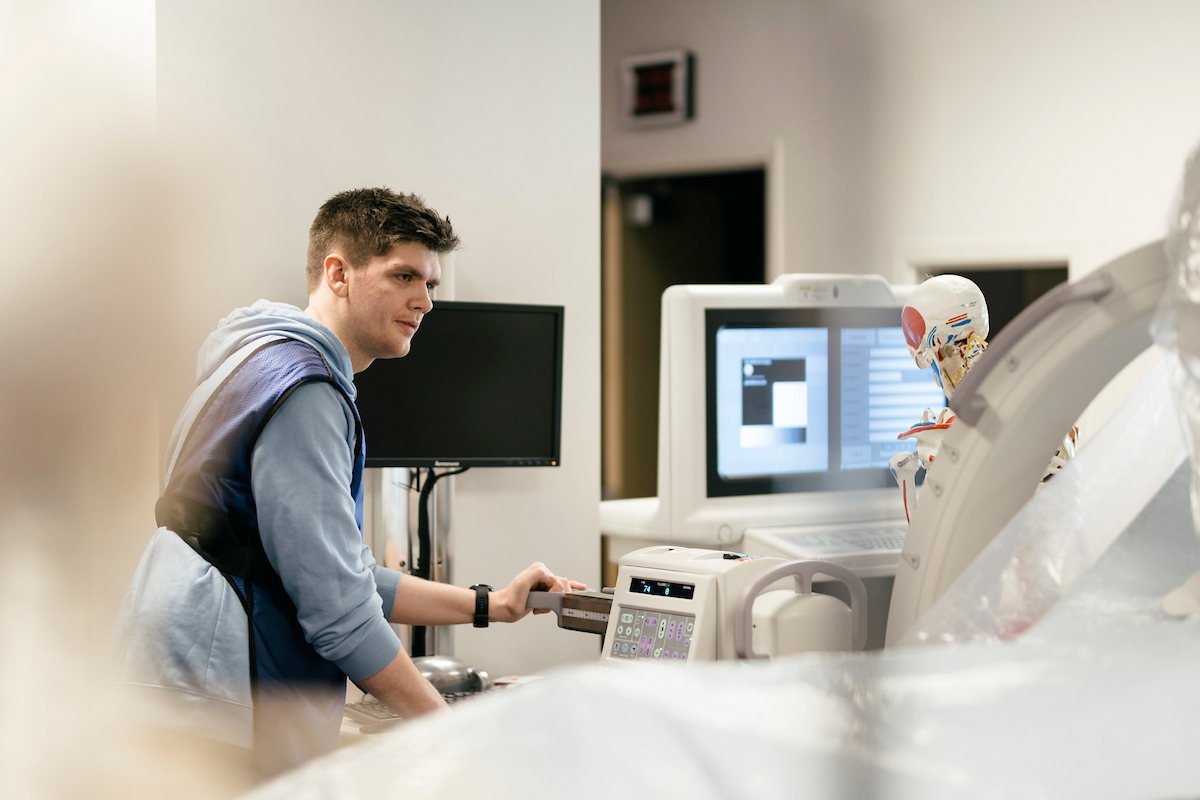
“Our students experience more than 1,400 hours of clinical work at multiple locations during their studies. They also practice during their on-campus lab classes,” Lackscheide said. “We have four X-ray machines plus five simulator tables. Our students practice on ‘phantom’ patients so they learn to correctly position people of all different shapes and sizes. By the time they graduate, students have had the repetition that allows them to work independently and efficiently in the profession.”
The radiologic technologist degree is the foundation for other training. Once people have completed this program, they can also cross-train for additional diagnostic certificates, including MRI, CT scans, mammography and more.
What’s the career outlook for radiologic technologists?
“Our clinical rotations are like long job interviews. Our clinical partner sites say that GRCC graduates are prepared for independent work, and that’s a competitive advantage,” Lackscheide said. “Many students are hired at one of the locations where they did their clinical rotations. I also receive job postings from all over the state as well as from many parts of the country. These often come with lucrative signing bonuses. It’s not hard for a qualified person to find employment.”
In addition, the ARRT certification is nationally recognized. Some states require an additional exam; however, most just have a fee to become registered in that state. That means this degree is portable.
Students who are thinking about this degree will find that GRCC’s program is designed for real life. In addition to hands-on work and job preparation, GRCC also offers a condensed weekly schedule for students.
“We condense our classroom and clinical work into four days per week. That is incredibly helpful for our students, especially those who may be adult learners, returning learners or parents,” Lackscheide said. “They have one day per week to deal with life needs, such as doctor’s appointments, grocery shopping and more. We have found this substantially increases our attendance rates and decreases the chaos for students.”
Students who attend classes at GRCC’s Lakeshore Campus in Holland also can benefit from the radiologic technologist program.
“All of the prerequisites for this degree can be completed at our Lakeshore Campus,” Lackscheide said. “After the first year, we also offer the specific radiologic technologist courses in a hybrid format. We do have clinical partners on the lakeshore and we offer the first choice of those locations to students from that area. It is very possible for a student to drive to Main Campus only one day per week depending on the semester.”
Learn more about the radiologic technologist program at GRCC.
This story was reported by Julie Hordyk.