
Sept. 22, 2026
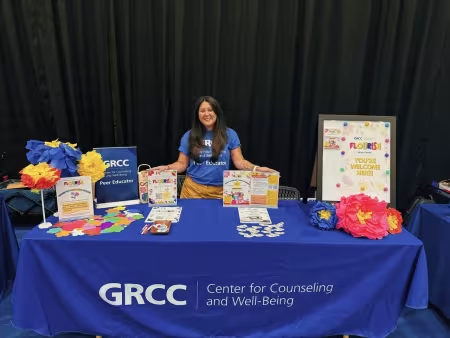
Toni Keniston, a current Grand Rapids Community College student, created Flourish, a neuro-affirming mental health peer-support program in partnership with GRCC’s Center for Counseling and Well-Being and the Center for High-Impact Experiences. Her path to higher education began at age 36, following years of building life skills and developing a clearer sense of self.
“In many ways, I was just passed through the school system,” Keniston said. “I went unnoticed because I masked well enough to play the part. I was polite and sat in a classroom, but my mind was constantly distracted. I never graduated and decided to move out when I was 17 years old.”
Keniston didn’t know she was dealing with undiagnosed ADHD at the time. Raised in an environment of poverty and abuse, her nervous system lived in survival mode.
“Not only was I unprepared for college due to my GPA, but I lacked basic life skills,” Keniston said. “I was floundering — unable to manage my time, understand my needs or fully support myself.”
Understanding Herself
In her 20s, Keniston married her husband, Zack, and had two children. After noticing neurodivergent characteristics in her children, she began to wonder about herself. Her own ADHD diagnosis provided clarity after years of feeling inadequate.
“I started accommodating and treating my disability for what it was,” Keniston said. “That brought massive progress. It’s a lot easier to be a zebra when you don't think you're a broken horse. Realizing I was a zebra gave meaning to my experience, and I stopped blaming myself for something that wasn’t my fault.”
Understanding her neurodivergence opened a new path. After attending a depression workshop led by Melissa Ware, head of the Center for Counseling and Well-Being, Keniston learned about the mental health resources GRCC provides.
Equipped with a diagnosis and newfound balance, Keniston recognized that many of her college peers were facing situations similar to those she had experienced in previous years.
“Returning to college in my mid-to-late 30s gave me a clearer perspective,” Keniston said. “I’m no longer trying to survive while pursuing an education.”
From Experience to Action
Keniston’s return to college came with a renewed sense of purpose. In her first semester, she earned a 4.0 grade-point average, made the President’s List and was nominated for the Honors Program.
Those achievements laid the groundwork for Flourish, which grew from data Keniston collected during an Honors Project focused on student mental health engagement. She observed that students rarely used available free mental health resources despite a clear need.
“Recognizing that gap — not knowing what I needed while undiagnosed — was central to creating Flourish,” Keniston said. “I asked myself why I hadn't sought mental health support back then. I had internalized the struggle as a personal failure rather than recognizing the problem. I didn't understand it could stem from a disability or CPTSD.”
Building Flourish
Keniston found renewed purpose in helping others reach their own realizations while advocating for systemic change. Losing her father in March of 2025 forced her to reflect.
“I hope to make a softer world for my children and everyone else through meaningful change,” she said. “We’re not all horses. Some of us are zebras, and that’s OK.”
Rooted in neuro-affirming principles and the Filipino concept of kapwa — a belief in deep interconnectedness — Flourish emphasizes community care without barriers.
Shortly after moving out at age 17 and realizing traditional school was not working for her, Keniston worked as a server. During that time, her manager shared a metaphor: Imagine people standing in a circle around a beach ball. Each person sees a different color depending on their vantage point. While their perspectives differ, none are wrong.
“Embracing different ways of thinking is the foundation of Flourish,” Keniston said. “Understanding that we can all process the world differently allows us to accommodate ourselves and each other.”
As a result of those collective experiences, Keniston built Flourish around four core pillars: Rooted, Reaching Out, Resilient and Radiating. The program aims to accommodate individual learning styles, encourage peer connection, build resilience through mental health literacy and train students to recognize and support peers in distress.
Flourishing Together
Keniston’s research revealed that students often “disclose sideways” — confiding in nearby peers rather than teachers or counselors.
“Students confide in peers who aren't trained to handle that depth of information,” Keniston said. “It can be as simple as someone saying a test feels impossible.”
Embracing that concept, Keniston designed Flourish to create more spaces for open dialogue to help students understand their own and each other’s perspectives. She believes this mindset can help individuals better understand what each person may need to bloom where they are.
“We want to build a community where we can support one another and move from floundering to flourishing,” Keniston said. “I was able to find this growth after embracing all of who I am, knowing mental health played a huge part in that journey. My hope is to make that available for everyone so we can all bloom together.”
Looking Ahead
In addition to her coursework at GRCC, Keniston runs a freelance business as a writer and artist, designing tarot and oracle cards. After pursuing her research during the summer and founding Flourish, Keniston’s artwork shifted from focusing on technique to prioritizing how she conveys raw human emotion and vulnerability.
She plans to transfer to Grand Valley State University to earn a bachelor’s degree in sociology, with long-term goals of attending graduate school and eventually teaching at the collegiate level.
Visit the Center for Counseling and Well-being web page to learn more about Flourish and the mental health resources available at GRCC.
This story was reported by Anjula Caldwell.