Feb. 25, 2026
When you hear the words, “Carnegie Hall,” what comes to mind? Many of us visualize a grand hall filled with tuxedo-clad musicians, creating gorgeous and seemingly effortless music to thunderous applause.
That magic does happen, so the images are not wrong. But have you ever wondered how those talented people reach the stage in the first place? The Carnegie Hall stage is not open to just anyone. What were their journeys like?
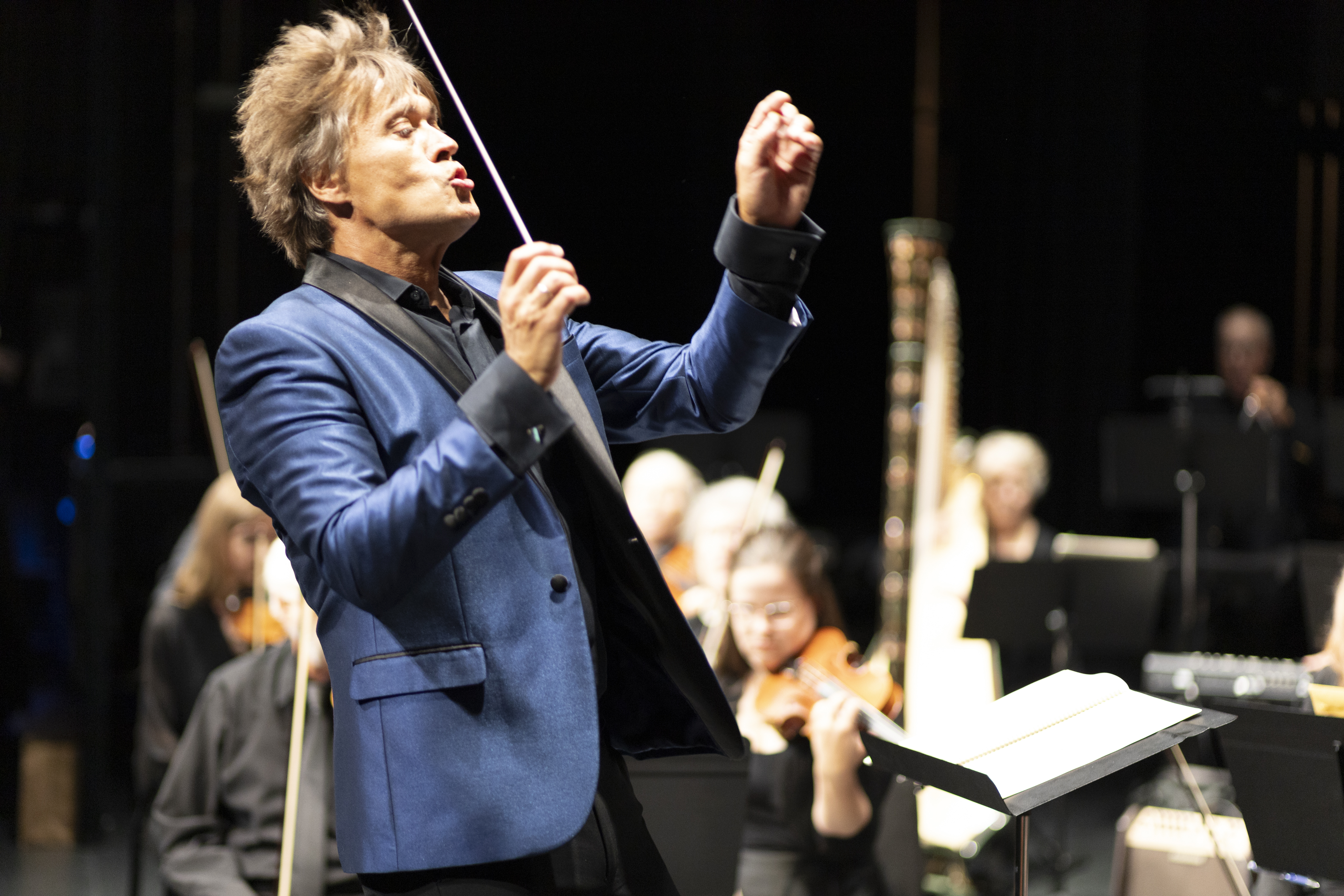
GRCC is pleased and proud to announce that our very own Dr. Libor Ondras, associate professor of strings and director of orchestras, will be returning to perform and make his conducting debut at Carnegie Hall on June 8. He will lead the Great Lakes Chamber Orchestra of Petoskey as they perform works by Dvorak, Bruch, Daugherty and Milhaud.
Dr. Ondras knows firsthand that the appearance and the applause are neither effortless nor automatic.
“My musical beginnings in Czechoslovakia were anything but smooth” he said. “I started lessons with a beat-up violin and a teacher who sometimes showed up, sometimes did not. Even when he showed up, he talked more than he taught. I probably did not have a normal lesson my entire first year.”
Ondras’ parents found him a new teacher, but with one rather large catch. He had to commute 25 miles there and back two times per week — using public transportation — as a 9-year-old. And that was just the beginning.
“My journey was full of peaks and valleys,” Ondras said. “I would grow for two or three years, then struggle. More growth would come, followed by more challenges. It was never a steady course. I realized that I had to take charge of my own learning if I wanted to succeed. But through it all, I had teachers who inspired me to work hard and get to where I needed to be.”
Dr. Ondras learned, through experience, about the power of experiences and mentors to shape a career trajectory.
“My early Conservatory education included ensemble participation,” he said. “During choir, the teacher asked me to assist with directing rehearsals. Suddenly, I had this whole new perspective on music. Instead of looking at it horizontally — understanding my linear role as a violin player — I was viewing music vertically. I had to read a complete score, deal with the harmonies, and understand how the voices fit together.”
Thanks to that experience, Dr. Ondras found himself exploring conducting more seriously.
“In Prague, I studied with a viola teacher who was also a world-renowned conductor,” Ondras said. “Many of my viola lessons ended up at the piano with a discussion of scores! When I came to the United States to complete my doctorate in viola studies, I chose conducting as my secondary focus. By the time I completed my doctorate, I was auditioning for orchestras, but knew I wanted to direct as my primary job.”
Dr. Ondras came to Michigan because it offered him a way to fulfill many of his professional aspirations. He teaches at GRCC, directs the community members of the Kent Philharmonic Orchestra and leads the professional musicians of the Great Lakes Chamber Orchestra.
As the maestro of Great Lakes Chamber Orchestra, he once again had to engage in strategic, patient development that would qualify the group for something as monumental as Carnegie Hall.
“Over the last 10 years, we have raised the bar,” he said. “We doubled our season and created outreach opportunities for students. We performed a European tour, and we earned an award from the League of American Orchestras. We performed with wonderful soloists from the United States and abroad. All of these experiences created a scaffold of success that allowed our musicians to rise higher than they dreamed possible. Our performance at Carnegie Hall will be a milestone upon which to build the next decade of excellence.”
All of these experiences have shaped Dr. Ondras into the kind of teacher who can relate to GRCC students.
“I would have loved a straight road for my musical journey, but that’s not how it happened,” Ondras said. “And when I meet and talk with students at GRCC, I realize they are not all on smooth paths, either. I want to be the mentor who makes a difference for them. Students come here with hopes and dreams, as well as with challenges and baggage. I hold high expectations but I never give up on them. And it’s wonderful to see things come full circle, as those students go on to earn four-year degrees, teach, perform and succeed. Three of my former students are even coming to Carnegie Hall with me — this time as my colleagues.”
Dr. Ondras steadfastly maintains that having a strategy, being persistent, and holding yourself accountable are the keys to success.
“I try to meet my students where they are, and help them evaluate where they want to go,” he said. “I can help them acknowledge the realities and create a holistic view of what is required. But then we also create a roadmap that gives the student ownership and holds them accountable, while keeping the dream alive. That is empowering. When I hear a student say, ‘I never thought I could accomplish so much in two years,’ I know my work is worthwhile. I am humbled when I see that I am making the impact I hoped to have.”
Learn more about the GRCC Music Department and its programs.
This story was reported by Julie Hordyk.