Oct. 6, 2026
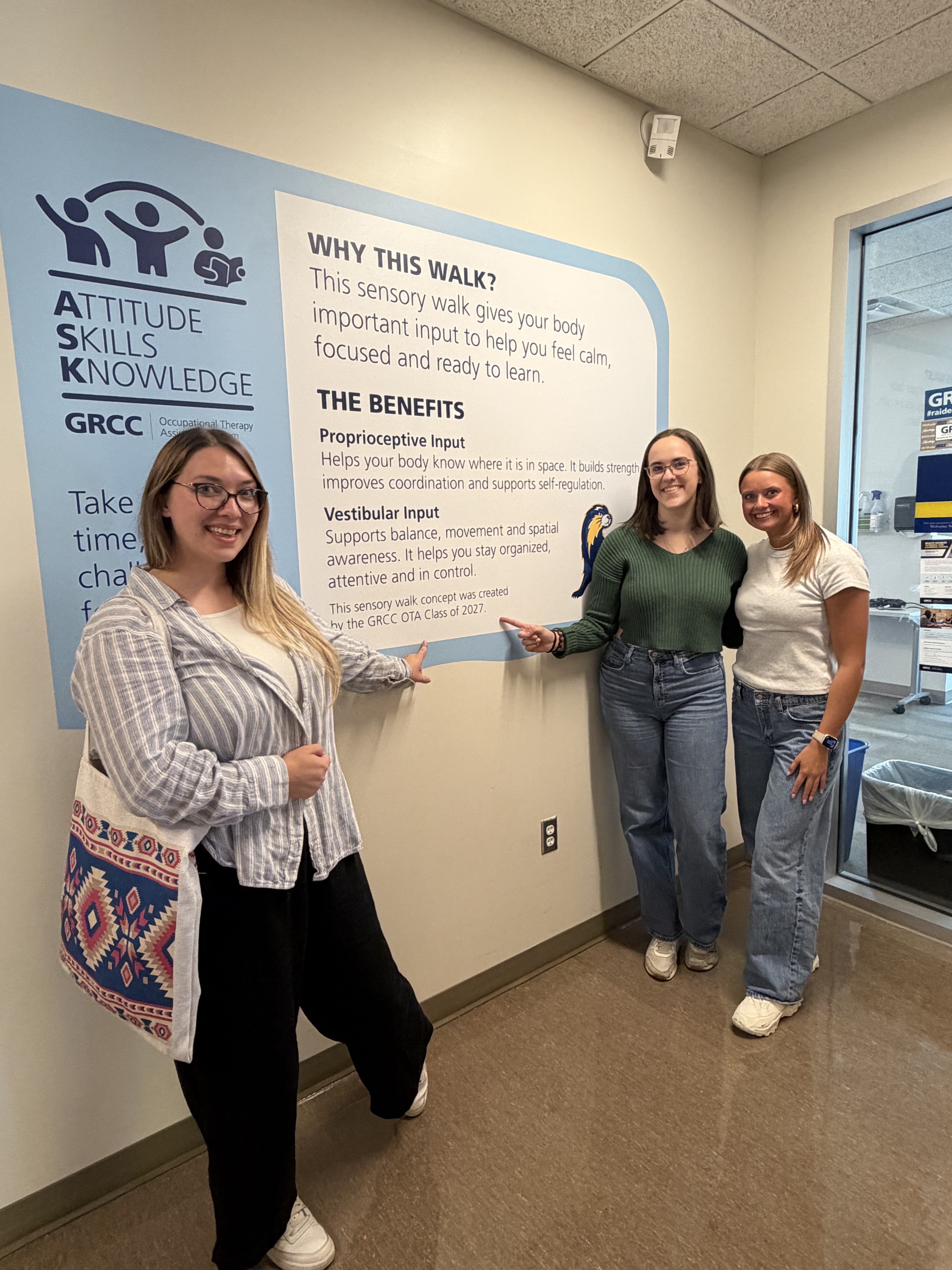
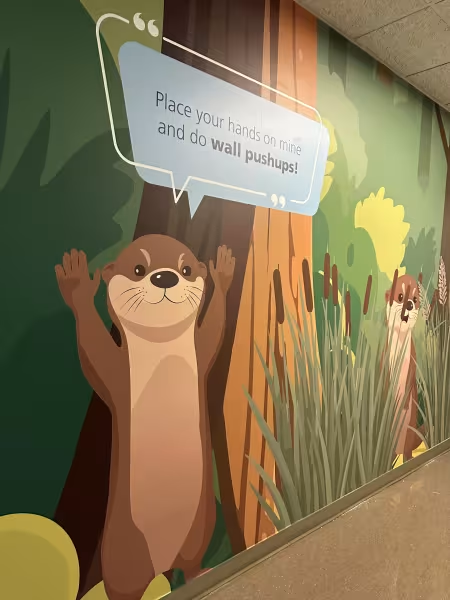
If you’re a fan of the River Raider, you need to stop by the Occupational Therapy department in Cook Hall and check out the new sensory walk. This playful pathway, which guides you through hops, skips and twirls, looks like a simple homage to adorable otters. However, it actually serves an important purpose by providing opportunities for sensory integration.
“Sensory integration” refers to the body’s capacity for interpreting, processing and responding to internal or external sensory signals, and then responding appropriately. This includes our traditional senses (sight, sound, etc.) but also our sense of balance, spatial awareness, and input from our muscles and joints. It’s an important part of child development, but it’s just as important for adults.
“People are sensory beings,” said Dr. Robin Pegg, associate professor for the Occupational Therapy Assistant (OTA) program. “We need to process an enormous amount of information all the time. Most adults have learned to do this through natural processes, like physical play. It’s getting harder and harder, however, because we are all becoming far more sedentary. We’re losing touch with some of those normal ways our bodies learn to process what they experience.”
When the Student Occupational Therapy Association started considering ideas for its annual community service project, they landed on the idea of creating a sensory walk at GRCC. A sensory walk incorporates specific, fun ways to move that effectively prod the brain. Three OTA students shared their experience of turning the idea into reality.
The Genesis of the Walk
“We thought the walk made sense because we have so many kids on this floor,” said Emily Hultink, president of the Student Occupational Therapy Association. “They come from the Early Childhood Learning Laboratory and we work with them in our sensory gym. Having the walk right here would make it easy to integrate into daily activities.”
Sydney Kline, vice president of the organization, says that fellow student Mikhaelah Osborn came up with the otter theme. “We all loved it and the ideas started piling up! There were so many ways to tie in our mascot as well as the natural beauty of West Michigan.”
Over several meetings, the team refined their ideas together.
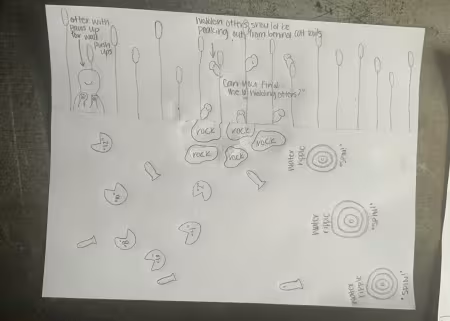
“We had some pretty wild concepts at first,” Hultink said. “We got a little out there, envisioning things like fishing poles on the ceiling! Dr. Pegg advised us to narrow it down to a two-dimensional approach. Sydney did a great job of sketching out our final plan. Then we collaborated with graphic designers in GRCC's Marketing and Communications department to bring it to life.”
Mikhaelah noted that the selection of movements was intentional.
“People know about the traditional senses,” Osborn said. “But they don’t know as much about proprioception, which is understanding your body’s position in space. The movements we chose, such as spinning, give the body a lot of feedback. The whole walk provides input while the users are engaging in natural play.”
The Educational Value of This Project
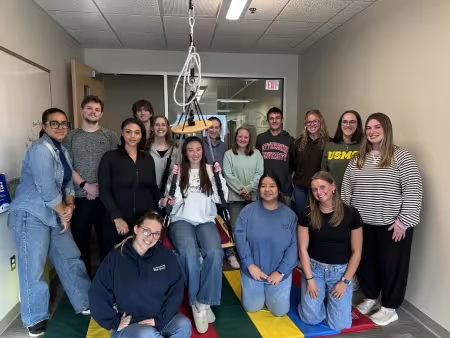
Accredited OTA colleges are required to have a chapter of the Student Occupational Therapy Association, a student-run, pre-professional campus organization that supports academic, leadership and professional growth. The students agree that membership is significant.
“Our chapter offers many opportunities to volunteer in the community,” Kline said. “We engage in activities we wouldn’t normally get to do, and that’s helpful. This project in particular taught me a lot about sensory integration and the importance of movement.”
Mikhaelah noted that the project reinforced the value of collaboration.
“We all worked together, and then the art department took our crazy sketch and made it amazing,” Osborn said. “As a team, we created something better than any of us could have done alone.”
For Emily, the project transformed her view of herself as a student.
“When we first started the work, I thought it would be fun for kids and students, but that was about it,” Hultink said. “Then when we got into the design, my perspective switched. I realized we are doing something that will have a positive impact on hundreds of people far into the future. We’re serving our community and future students in a tangible way, even though we won’t be here to see it.”
That observation warms Robin’s heart.
“We are really proud of the culture of professional learning and community investment at GRCC,” Dr. Pegg said. “We want our students to behave as professionals, and part of that is giving back. Being involved in the student organization helps imprint those standards into each student.”
Continued Excellence in the OTA Program
The OTA program at GRCC serves a significant and ongoing health need.
“OTAs are intervention specialists, and we need them now more than ever,” Dr. Pegg said. “We have an aging population. We have a rising number of kids with learning and behavioral needs. One in 31 kids has autism. OTAs are vitally important for all these groups. And GRCC has the largest OTA program in West Michigan. Our program is consistently held up as a model for others.”
The sensory walk is another tangible tool that helps students learn their craft.
“We have three semesters of classroom time to pour 74 accreditation standards into our students,” Dr. Pegg said. “From an education standpoint, things like the walk and sensory gym let our students practice real tools with real kids in real time. That’s priceless.”
The legacy implications for the program are the bottom line for Dr. Pegg.
“This project is part of a longer tradition in our OTA program,” Dr. Pegg said. “Previous groups created sensory walks for schools in our community. What makes this one especially meaningful is that this group brought that idea back to GRCC. They're leaving behind something that will support the college community and help teach future generations of OTA students.”
Visit the Occupational Therapy Assistant A.A.A.S. web page to learn more about the program and courses.
This story was reported by Julie Hordyk.