April 6, 2026
When it comes to the subject of math, many people think you’re either math minded or you’re not. A common misconception is that some people simply aren’t “good at math.” At Grand Rapids Community College, Mathematics department head, Monica Bliss, leads faculty in applying a growth mindset approach to challenge that belief.
“Students often come in with a fixed mindset. They think their intelligence is fixed,” Bliss said. “But people with a growth mindset believe their intelligence can grow and change. When they make a mistake, they’re not worried about being judged. They’re more concerned with how they’re going to learn from it.”
That philosophy drives instruction in many of GRCC’s math classrooms. Faculty emphasize effort as the key to improvement and frame setbacks as part of the learning process. Instead of avoiding mistakes, students are encouraged to work through them and find new paths forward.
A Teacher Can Make the Difference
For many students, their perception of math is shaped by past classroom experiences. Teachers who believe all students can succeed tend to make math feel more accessible. Those who don’t can leave lasting doubt.
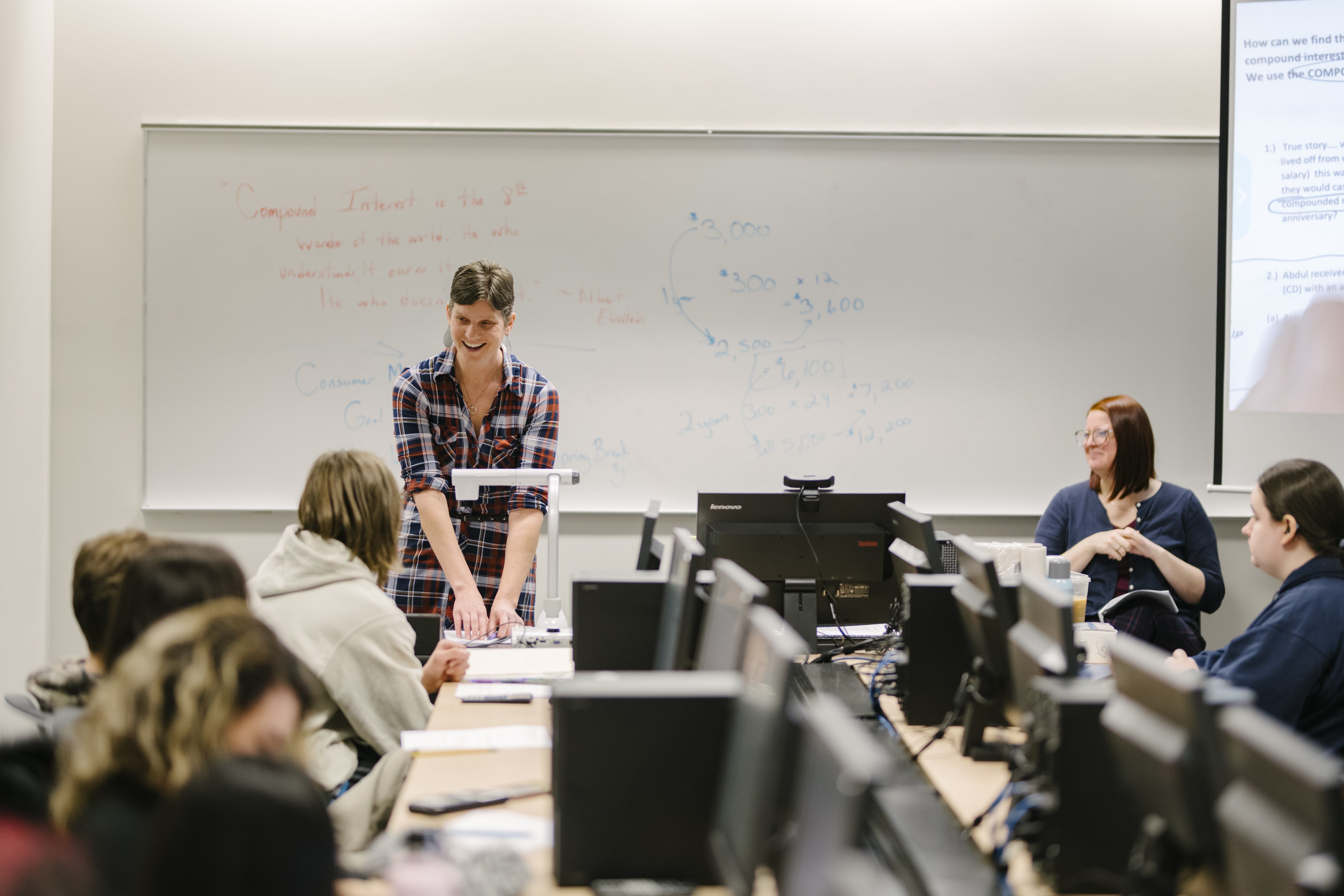
Instructor Jodi Dawson, who has taught at GRCC for almost 20 years, said her approach begins with recognizing each student’s potential.
“Teaching is about recognizing every student has value,” Dawson said. “I go into every class wanting to help every student be successful.”
She said creating a supportive classroom environment is essential. Students need to feel at ease stepping outside their comfort zones and making mistakes.
“I believe anybody can learn math. I don’t believe they have to love math,” Dawson said. “I work to establish a trusting relationship where students feel safe to get things wrong and ask questions. I don’t want them to just accept something because the teacher said so.”
For Dawson, building that sense of safety allows students to see mistakes not as failures, but as progress.
“We should celebrate the process,” she said.
Tutoring as Part of the Process
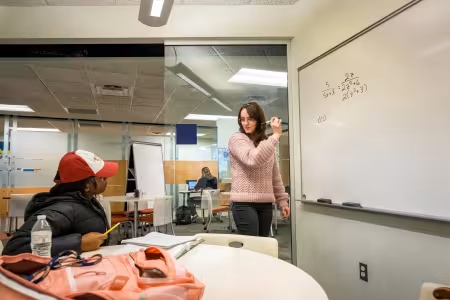
Support extends beyond the classroom to tutoring centers where students can access help for free and without an appointment. Jeremi Merrill, a Promise Zone tutorial center coordinator, works with students who may lack confidence.
“There might have been people who made students believe they were bad at math,” Merrill said. “Often, students get most of the process correct but focus on what they got wrong.”
Addressing a single misunderstanding can unlock broader success, he said. Fixing one small error often creates momentum, helping students build confidence step by step.
Merrill also encourages students to be more open in their learning.
“I talk to my students a lot about being willing to be vulnerable in math class,” he said. “My classes evolve into group discussions. Students share their thinking in real time instead of waiting to raise their hands.”
That collaborative approach helps shift students from feeling incapable to seeing themselves as problem solvers.
Math Is More Than Solving an Equation
Many people believe math belongs only in the classroom and has little relevance in daily life. While most people don’t solve equations at the gas pump or calculate square roots on the job, the underlying skill — problem-solving — is used constantly.
“Math is really about the process of problem-solving,” Bliss said. “When you start working through new ways to achieve a solution, you are problem-solving. It can be math-related or something in everyday life. Math is all about the process. It helps curate the mind into feeling confident to problem solve one step at a time.”
Students who learn to break problems into steps and recognize small successes tend to be better prepared over time. This approach keeps the growth mindset central to their learning. It shifts the focus from simply getting the right answer to understanding how to get there.
It is often through mistakes that the most meaningful learning occurs.
“When a student gets a question wrong, it’s because they had the courage to try,” Dawson said. “The success is not in getting it right. The success is finding the mistakes and asking how we move forward.”
She added that traditional classroom norms can discourage that mindset.
“For so long, we’ve been taught not to speak unless we have the right answer,” Dawson said. “The real power is recognizing that making mistakes is where growth happens.”
Anyone Can Do Math

GRCC’s Mathematics department works to put the growth mindset principles at the center of its classrooms, with the goal of helping every student feel capable and supported.
“There are always people who say math isn’t their favorite or they’re not good at it,” Merrill said. “But you have to keep trying. If teachers give up, students will, too.”
That persistence is key to building trust in the learning process. Faculty work to reinforce the value of effort and consistency, helping students see progress over time.
Teaching with a growth mindset requires planning and patience. It can also require more time in the classroom, particularly when students are encouraged to approach problems in different ways.
“I think one of the differences with a growth-minded professor is being okay with 20 students getting the correct answer using 20 different methods,” Dawson said. “It’s much easier to have everyone use the same method, but it’s not as rewarding.”
For Dawson, the payoff comes in watching students change how they see themselves.
“Seeing students go from believing they’re not math-minded to knowing they’re capable—that’s a refreshing and uplifting feeling as an educator,” she said.
Visit the Mathematics department web page to learn more about their areas of study.
This story was reported by Anjula Caldwell.