Feb. 6, 2026
It’s challenging to replace someone who has done an incredible job of building a program. Fortunately for GRCC students, the college has met that challenge in the plastics program.
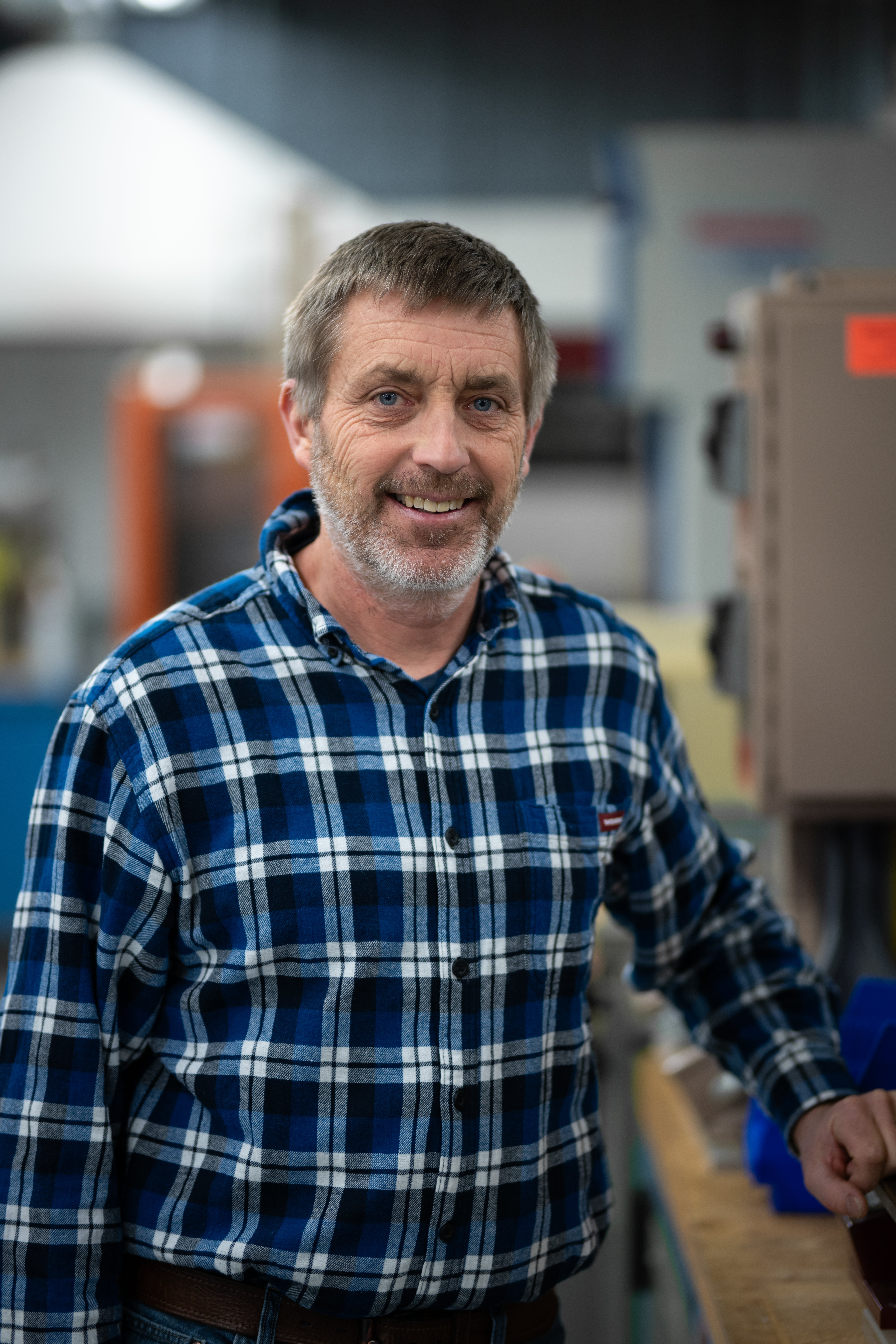
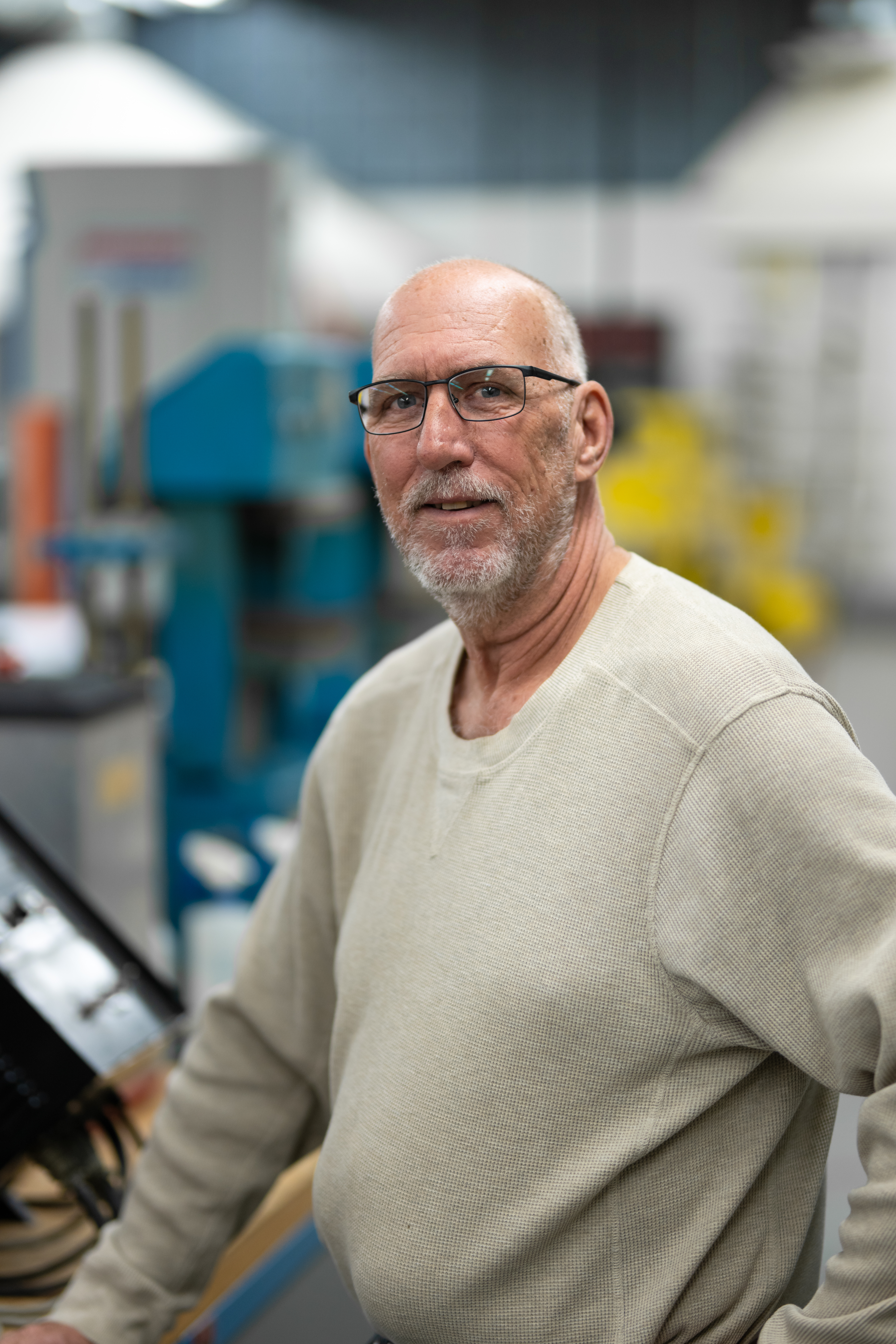
We extend our sincere and heartfelt thanks to Troy Walwood for his 30 years of work, building the Plastics-Polymer Engineering program within the School of Business and Industry. Troy will be retiring at the end of the winter semester, and his successor, Scott Van Hoven, is excited to “take the baton” and move the program forward.
Leading With Curiosity
What, you might ask, draws a person into plastics? Walwood says he intended to work at a paper company, but had an allergic reaction to the chemicals while on a tour. So he got a job at Prince Manufacturing instead.
“I didn’t know anything about plastics, but I knew it paid 25 cents more per hour than the paper manufacturer,” Walwood said. “My first job was to run a molding machine, making parts for the flip-up visor on a Suburban. Curiosity drove me to visit a Chevrolet dealer after work one day. I’m sure I confused the salesperson when I said I wanted to look at the visor, not buy the car. After seeing how my little part fit into the big picture, I was hooked. I had this constant desire to understand how and why the machines, the molds and the parts did or did not work.”
Walwood then worked for several large firms before transitioning into education.
“I used to bring a group of process techs to GRCC for classes,” he said. “After about three weeks, the professor asked me to talk to the class about injection molding tooling. Little did I know this was a pseudo-interview. By the end of the course, words like ‘adjunct professor’ had entered the conversation, and I did actually end up taking on that role. Finally, I left the industry to work full-time at GRCC. I spent 17 years in workforce development, and 13 years as a full-time professor.”
Scott Van Hoven took a more traditional route to the field, earning a bachelor’s degree and then working for 30 years in engineering and technical sales. He says he has always wanted to teach because he’s excited about sharing his knowledge and getting people into the industry.
“I love to teach new concepts and help people find their purpose,” he said. “Once you see how a pellet becomes a part that saves someone’s life, for example, that light bulb goes on. This is a fascinating industry with incredible potential. It’s taken me around the world and I’ve met amazing people. Most folks don’t think about those kinds of opportunities when they think about plastics.”
Reflecting on the Past
Mammoth changes have taken place in plastics over the last 30 years. As with many industries, automation has played a huge role in how the plastics-polymer engineering industry has evolved.
“When I started, every process was manual,” Walwood said. “I had to take parts out of the mold, quality check them and pack them. I didn’t see my first automated mold changeover until I’d been working for nine years. Now, robots do virtually all the manual work. It used to be that a 3% defect rate was acceptable. Today, the standard is zero defects. From an employment standpoint, technicians need to understand the molding process, but also quality control, robotics, and automation. It’s a whole different skill set.”
That’s one of the reasons Walwood worked to put the Master Mold Builder Certification in place at GRCC.
“Until a few years ago, I was a certified Master Molder Level Three Trainer,” he said. “The Master Mold Builder Program is a certification that’s recognized throughout the world. I brought the program to GRCC because it’s a wonderful way for companies to help employees gain skills and promote from within.”
Walwood notes that focusing on local employer needs has also been an important part of his role, one that Van Hoven is well-equipped to carry into the future.
“I have always loved working with students, especially those who are looking to upskill themselves to make a better living,” Walwood said. “I want to see both business and individuals thrive.”
Anticipating the Future
Van Hoven is quick to point out that plastics are emerging from the environmental cloud that once hung over them.
“It’s easy to give plastics a bad name by talking about how much ends up in the landfill,” he said. “But that’s not a foregone conclusion. Plastic goes into the landfill because people put it there. Most plastic can be recycled to reduce our use of virgin natural resources. It can also help with other energy efficiency goals, such as making cars lighter for better fuel economy. No other material gives the same benefit of plastic in the places where it’s used. The industry is aware of the environmental concerns and has taken great steps to reduce them. We actually talk about this in our introductory class.”
Both Walwood and Van Hoven believe that the future is bright for anyone who chooses a career in plastics.
“West Michigan is full of companies that manufacture plastic parts,” Walwood said. “Our Plastics Advisory Council is always lamenting that they need employees with a higher level of skill. They rely on GRCC to fill that pipeline with qualified people.”
Van Hoven also sees endless opportunities in the field.
“No one wakes up wanting to be a plastics engineer,” he said. “And yet, if you look around and see all the places where plastic interacts with our lives, you realize it’s a diverse industry. A career in plastics does not mean you’re working in a dark, dingy factory. This is a highly automated industry with sophisticated systems and big data. The programs at GRCC provide the education and credentials that employers need. With an education in plastics, you can develop a financially stable career right here in West Michigan, or go anywhere in the world.
Learn more about the Plastics-Polymer Engineering Technology certificate or associate degree.
This story was reported by Julie Hordyk.