March 31, 2026
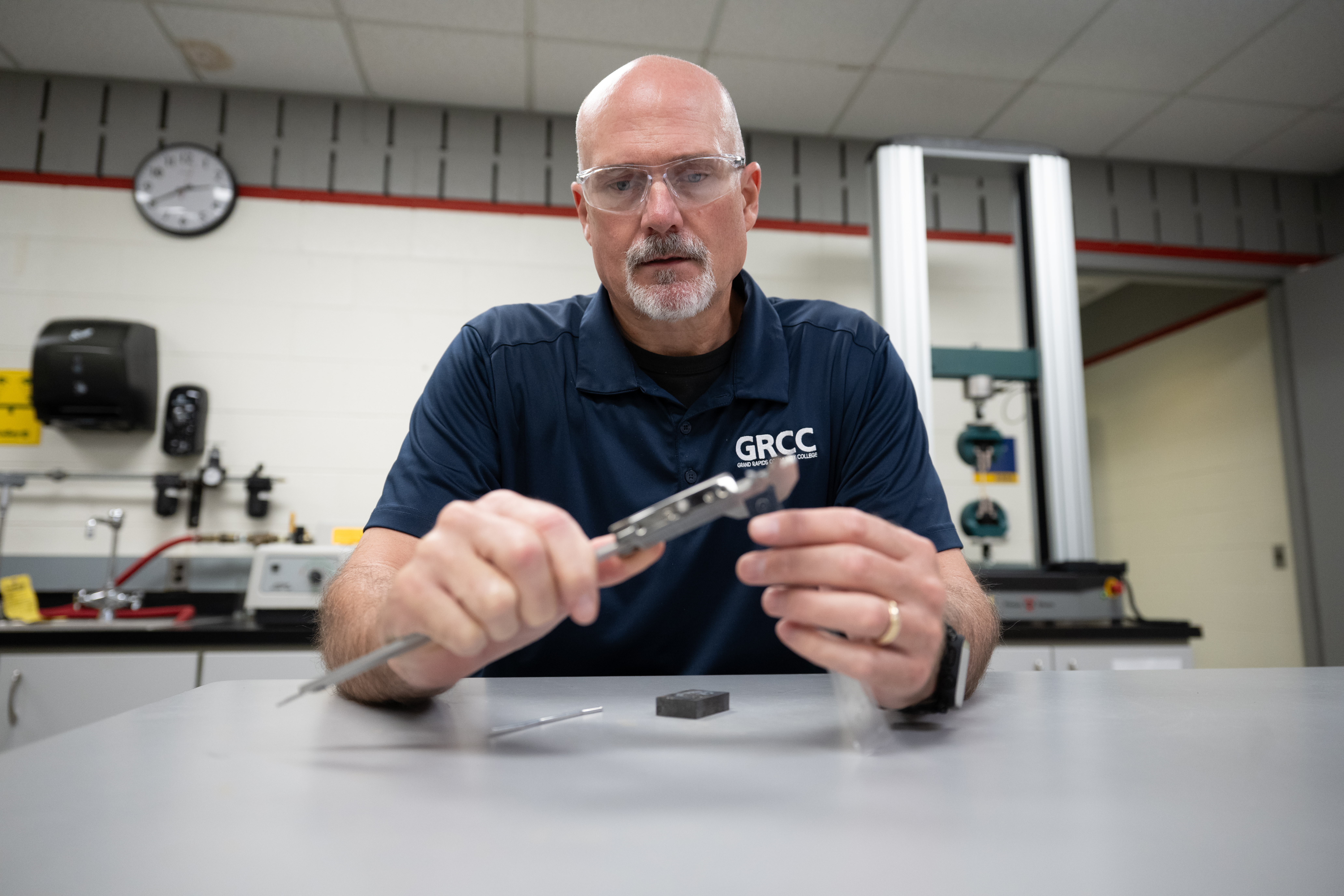
If there’s one thing common to most people working in quality control, it’s the fact that they didn’t choose the job. As Chris McDonald, department head and assistant professor of the Quality Science program can tell you, most of the people who come through the program have been “volun-told” into the position.
“Most of our students have been in the workforce for five or six years,” McDonald said. “They may have started as operators, then moved around to material handling, or shipping and receiving. If they have a knack for problem solving and attention to detail, they often get tapped on the shoulder for a quality control position.”
Frame a New Role With Learning
Why does quality control matter? Jessica Butler, a student in the program and Gentex employee, can tell you exactly why.
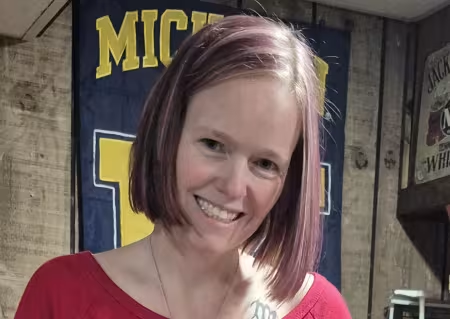
“After working for six months at Gentex, I was asked to be a line supervisor in quality control,” Butler said. “I did that job for three or four years and really enjoyed it, even though I had no formal training. One day, a part came through that was making a clicking noise it shouldn’t have been making. I refused to pass it. In fact, I stopped production. At first, that didn’t go over so well! After more investigation, we found that we had to scrap 4,000 pieces due to a defect.”
Butler stopped production because her instinct told her it was the right thing to do. Now, as she’s completing her Quality Science Certificate, she has the knowledge to back up her decision.
“I can associate what we’re reading with things that happen at work every day,” Butler said. “Looking back, I now know that my decision to stop production, and the reason the higher-ups backed me on it, was because we were looking at long-term goals versus short-term goals. In the short term, shutting down production hurt. We didn’t make our ship date. But if we had shipped defective parts to meet a short-term goal, they would have been returned for rework, which is expensive. More importantly, we might have lost the customer. In this case, the long-term goal of customer satisfaction was far more important than the short-term goal of on-time shipment.”
Butler had attended a couple semesters of college many years ago but didn’t feel compelled to finish a degree. Now she found herself wanting more knowledge in order to keep advancing.
“I like solving problems and I saw the promotion opportunities that were open to me if I had more skills,” Butler said. “My husband has been urging me to go to school, but I didn’t know how to juggle a full-time job and three kids, plus more education. Then I found the GRCC certificate program. The online format fit my life, so I signed up.”
Resources for Returning Students
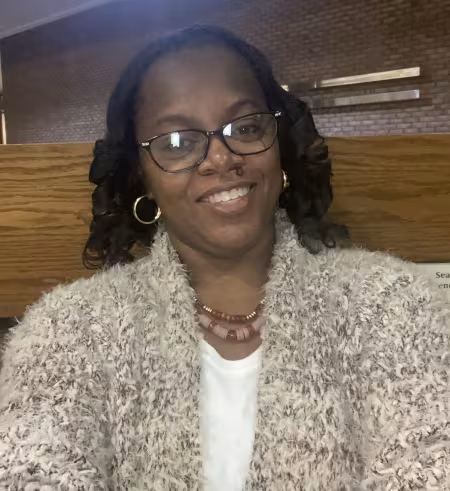
Jamila Williams is also taking the quality science certificate program this semester. She’s coming from the opposite end of the educational spectrum, having already earned an associate degree from GRCC, then a bachelor’s degree and master’s degree from GVSU. She has also come back for a Plastics-Polymer Engineering Technology Certificate, and then again for a Supply Chain Operations Management Certificate.
So why in the world is Williams back in school yet again?
“Quality was definitely not on my radar,” Williams says. “But I was recently promoted into a quality position at Cascade Engineering. I wanted the background knowledge to understand the ‘why’ behind the work. That thirst for knowledge is why I’ve come back to GRCC so many times. I’ve had such incredible experiences here. I knew this was where I could find the education I needed in this specialty.”
Williams, too, is juggling the demands of full-time employment and a family. She, like Butler, loves the convenience of the online program.
“I don’t have to make a class fit my life,” Williams said. “Instead, I can do the work when I have time. Now I’m learning the terminology and the theory to back up my hands-on experience. The professors are great and they have tremendous experience in the field.”
Career Opportunities at Little to No Cost
Chris McDonald is quick to point out that both Butler and Williams are reaping the benefits of a certificate program with no out-of-pocket cost.
“Very few, if any, students pay for this program themselves,” McDonald said. “Either their company has an educational reimbursement program, or they qualify for free education through Michigan Reconnect. Not only are they gaining valuable knowledge at no cost, they are also making themselves more valuable and creating advancement opportunities.”
Williams confirmed that the career implications of her studies are real.
“Cascade Engineering promotes from within first,” Williams said. “When you prove your abilities, they will help you advance. It’s easy for them to get more operators from a temp agency, but more advanced skill sets are harder to find. Having this kind of education just makes me more valuable and gives me more options for my career. I already have a potential opportunity to advance into Quality Assurance Systems this fall.”
Coming Soon: Associate Degree in Quality Science
McDonald is excited about bringing additional learning opportunities to students next year through an associate degree in quality science.
“The certificate is a great way to get started in quality,” McDonald said. “Students learn to use the tools the right way, which doesn’t always happen with on-the-job training. Starting with the Winter 2027 semester, people who find quality to be their niche will be able to continue learning and pursue their associate degree.”
Learn more about quality science at GRCC on the Quality Science department web page.
This story was reported by Julie Hordyk.