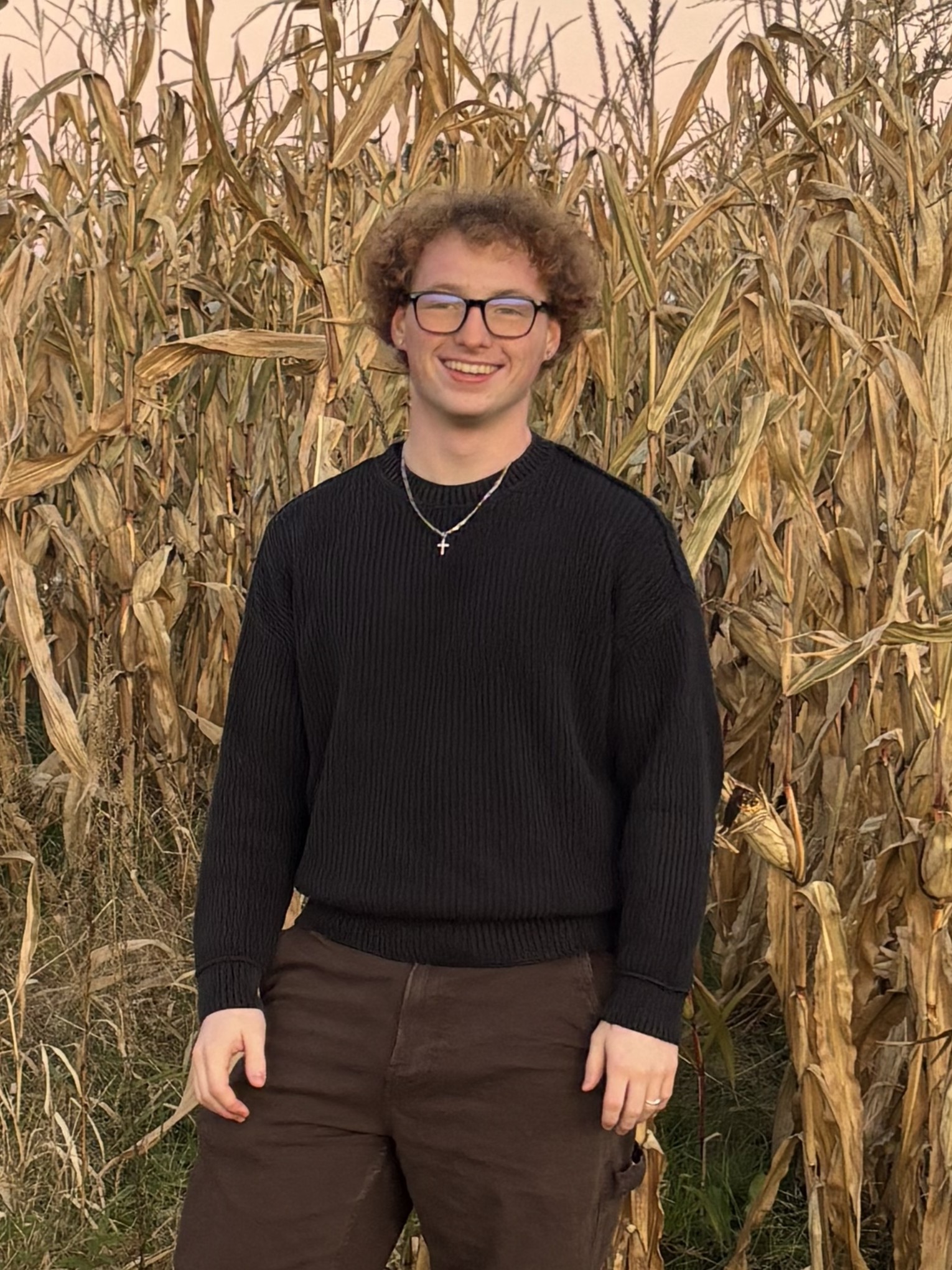
April 14, 2026
The piano has held special fascination for Tyler Watkins ever since he was young.
“When I was 12, I received a mini-keyboard with about 40 keys,” Watkins said. “I loved playing it, and kept trying to learn songs. My parents bought me a full-size keyboard for my 15th birthday. Once I started learning contemporary music on that, I was hooked.”
Watkins is pursuing a recording technology associate degree, with the dream to someday write movie scores. He came to GRCC not only to finish up his gen ed requirements, but also because the music program receives top ratings among Midwest colleges.
“I love the intricacy of a good score,” Watkins said. “I think I hear things that other people don’t hear in those pieces. ‘How to Train Your Dragon’ is probably one of my favorite scores. The music is so fitting for each scene. I want to be able to create that kind of magic.”
Earning his recording technology degree from GRCC is the first step, and then he hopes to transfer to Western Michigan’s music program. Watkins knows that building connections in the movie industry will take time, so he also plans to teach for a while.
Coaching from a Pro
Professor Jonah Elrod, an accomplished composer himself, noticed Watkins’ composition talent and encouraged him to submit a piece for the 2026 Jack Stone Award for New Music. Each year, community college student composers from around the United States submit pieces for varied instrumentations, and these pieces are judged by members of the Composers Alliance of San Antonio.
A winner and two runners-up are selected, and they are then flown to San Antonio, where they get to meet and form lifelong friendships in addition to hearing their works premiered by top-notch professional musicians. They receive a recording of their works, and the concert is preceded by a master class involving the musicians and at least one of the judges, allowing the students valuable opportunities to learn and grow as composers.
Although the Jack Stone competition was open to community college students from all over the United States, professor Elrod thought Watkins was ready to compete on that stage. And in this, Watkins’ second-ever composition competition, he received one of the two runner-up awards.
“This win is going to push me forward,” Watkins said. “It reinforces the idea that this is something I can do. The win is great to put on my resume. However, even better than the win is what I learned when I went to San Antonio. Hearing my piece performed by the actual instruments brought it to life. I learned so much on that trip about instrumentation, phrasing, and even breathing for woodwinds. It taught me how to better orchestrate my music.”
Professor Elrod is thrilled that Watkins was able to advance his compositional skills through the competition and the benefits that came with the win.
“It’s a huge educational experience to interact with musicians at that level,” professor Elrod said. “Tyler was able to meet people and had to explain his music. That’s a skill that only comes with practice, so this was a great way to acquire it. He also made some wonderful connections, and got to interact with the faculty at Northwest Vista College. Those are priceless experiences.”
About the Music
Watkins titled his piece, “This Garden of Reverie,” and explains that it moves the listener through a journey of self-reflection.
“The music begins with someone walking through a peaceful, calm garden,” Watkins said. “As the walk progresses, the scenes change and become darker. This song reflects the polarity of our minds. We can be peaceful when our minds allow us to be, but we can also become our own worst enemies when we allow fear to take over.”
Professor Elrod notes that regardless of where Watkins’ career takes him, this award can do nothing but help.
“Tyler’s music is really special,” Professor Elrod said. “He is already so mature in his phrasing and the way he plans his music. He’s careful and expressive, not rushing from idea to idea. After only one year, his music has a maturity that’s hard to develop. If he wants to go the self-published route, this adds credibility to his work. If he wants to teach, he can say he won a competition. I hope the win opened his eyes and gave him confidence, because he is really talented.”
Visit the Recording Technology, A.M. web page to learn more about this program.
This story was reported by Julie Hordyk.