July 23, 2026
Most of us would probably use the word “recent” to describe an event that happened within the last month or so. For paleontologists, however, “recent” has a much different meaning. Just ask Paul Kuchnicki, a GRCC graduate who combined his passion for art with a love of geology, and is discovering numerous ways to use his skills.
Scientific Interpretation Meets Artistic Skill
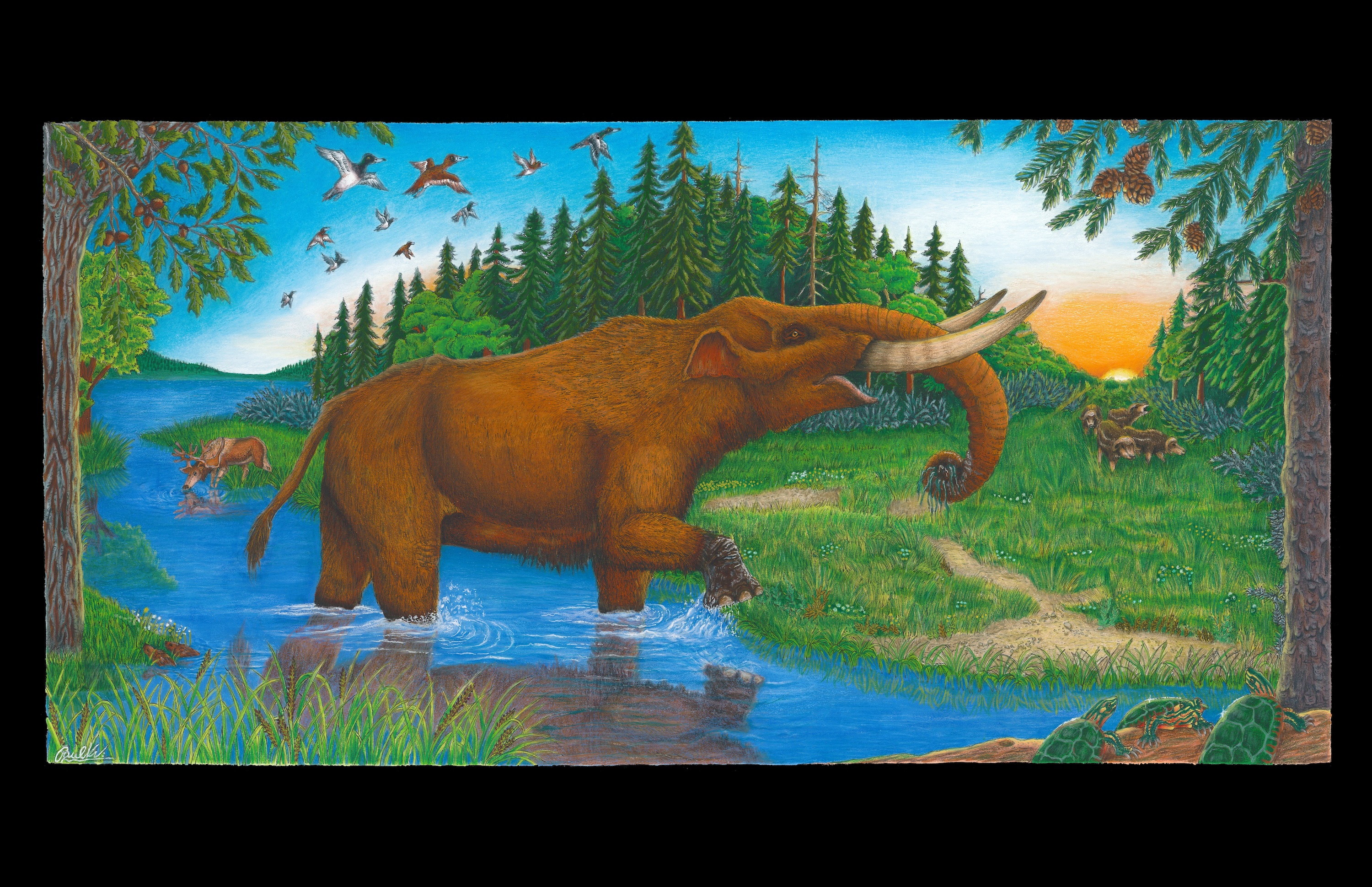
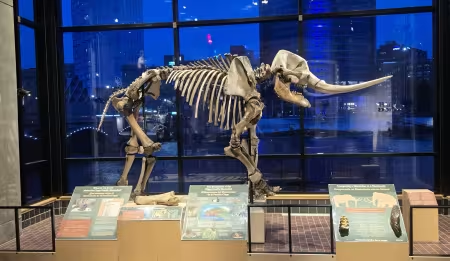
“Thanks to an introduction from Professor John VanRegenmorter, I was invited to collaborate with Grand Rapids Public Museum on The Clapp Family Mastodon exhibit,” Kucnhicki said. "The 70% complete skeleton was found in the family’s back yard during a construction project north of Kent City. The bones were so well preserved that carbon isotope dating could be used to determine the skeleton’s age. It turned out to be a little more than 13,000 years old.”
Although paleontologists deem this animal to be “recent,” an exhibit that brings it to life obviously can’t rely on firsthand descriptions. Dr. Cory Redman, Science Curator at Grand Rapids Public Museum, specializes in vertebrate paleontology and has worked with the GRCC geology faculty in the past. He wanted a reconstruction of the mastodon in its natural environment as part of the exhibit. Professor VanRegenmorter suggested that Paul, with his paleontology knowledge and artistic skills, could help.
“I appreciate that Paul is detail oriented,” Dr. Redman said. “We obviously don’t know exactly what these animals looked like. Paul reviewed the literature to learn about posture, anatomy and muscular structure. He also studied modern vegetation to make sure the pollen recovered from the sediment layers that produced the mastodon’s bone were accurately represented in reconstructing the animal's habitat. Paul uses in-depth research to channel his artistic interpretation. That’s a critical skill for anyone who wants to be a scientific artist.”
“A skeleton is impressive, but it doesn’t show how the animal would have looked or moved,” Kuchnicki said. “These questions captivate the human imagination, and that’s what I’m striving to achieve. Unlike a drawing created with AI, I’m using scientific information as the basis for creative interpretation. My mastodon illustration is probably the best piece of art I’ve done and it’s now on display for everyone to enjoy.”
Finding the Right Track
Paul started his college career as an art student, but things were not clicking for him. One of his art professors found out about Paul’s passion for paleontology and was amazed by the art he created around his favorite subject matter, dinosaurs. She encouraged him to switch degrees and that started the ball rolling. You can read more about Paul volunteering to locate fossil remains in Utah in an GRCC article published last year.
Paul graduated from GRCC in April and plans to earn his bachelor’s degree in geology at Grand Valley State University. However, before he heads off for that adventure, he has one more project at GRCC to finish.
A Generous Parting Gift
Tari Mattox, head of the Geology department, had a fossil that was just begging to be exhibited. And she had the perfect spot for it.
“Our fourth floor exhibit case is a great place to showcase educational displays for students as well as community visitors,” professor Mattox said. “We had an impressively-sized jaw fragment from something we initially suspected was a mosasaur, or a marine reptile. I always thought it would be interesting to create an exhibit based on it.”
Tari offered Paul the opportunity to put his creative skills to work and he jumped at the chance.
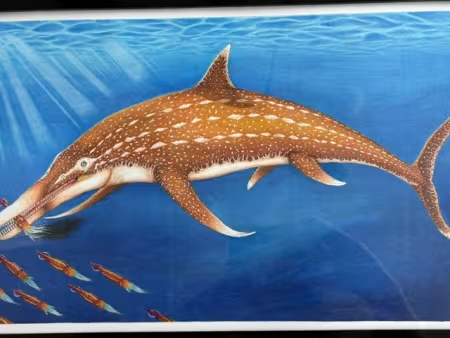
“The label on this fossil had deteriorated, so we didn’t know what it was,” Kuchnicki said. “Based on the bone structure and teeth, I thought it was an aquatic predator, maybe some sort of fish lizard, also known as an ichthyosaur. Professor VanRegenmortor reached out to an expert in the UK who said the same thing. That confirmation inspired my creativity, and I started visualizing both the animal and the exhibit.”
Paul’s exhibit calls for the fossil to be mounted in line with the drawing so that viewers can see it in context. He finds it exciting that this is one of the first fossils of its kind to be identified.
“This is one of the largest marine reptiles that appeared during the Early Jurassic period, 190-175 million years ago,” Kuchnicki said. “Our fossil came from a juvenile ichthyosaur that was about 18-21 feet long. Had it grown to adulthood, it could have reached 30 feet! Although the fossil is too small to identify down to the species level, I used what I could find about similar complete skeletons as the basis for my drawing. It’s humbling to know that my curiosity helped fully categorize and bring new life to this fossil.”
Opening Doors
Tari notes that Paul’s artistic skills, coupled with his intense passion for geology, will open innumerable doors.
“In order to draw, you have to understand at a deep level,” Professor Mattox said. “When I was a student, drawing was commonplace. Now, however, most people just take a photo with their phone. Drawing is a dying skill. Paul’s deep focus and complete fascination, along with his work ethic, are his strongest traits. I’ve had a handful of excellent students who were also excellent artists. Paul is the best I’ve ever had.”
Paul plans to complete the exhibit this summer before he heads to GVSU. He’s confident that his art, combined with his geology skills, will bring him into fulfilling work.
“My art has given me an edge for finding opportunities,” Kuchnicki said. “I love that I’m helping viewers imagine and step into a completely different world, one that is creative, but informed by all the scientific knowledge available.”
Visit the Pre-Geology A.A. web page to learn more about this program and learning opportunities.
This story was reported by Julie Hordyk.