Aug. 6, 2026
When you watch an Indiana Jones movie, do you find yourself wanting to go on a dig and discover something fabulous? If your answer is yes, there’s no need to head to Hollywood! Just connect with professor John VanRegenmorter of the Physical Sciences department and you’ll have many opportunities to discover.
“When I came to GRCC, I found boxes upon boxes of rocks, minerals and fossils in a back room,” said professor Tari Mattox, Physical Sciences department head. “I dug around enough to find samples for the classes I was teaching, but really didn’t have the time or expertise to catalog our entire collection. When I hired John, who has a master’s degree in paleontology, he started to unpack and figure out what we had.”
John notes it’s unusual for a community college to have a fossil collection of this size, which numbers more than 1,200 items. What’s even more unusual is that we have no idea where many of them came from.
“As I started digging, I found boxes labeled ‘Charles Sternberg’,” professor VanRegenmorter said. “There was a famous early fossil hunter by that same name who lived and worked out west in the late 1800s. I got a forensic handwriting expert involved, and found out it was quite likely our labels had been written by Charles’ son George, also a fossil expert. So we know that a significant part of our collection is from a pioneering expert in the field.”
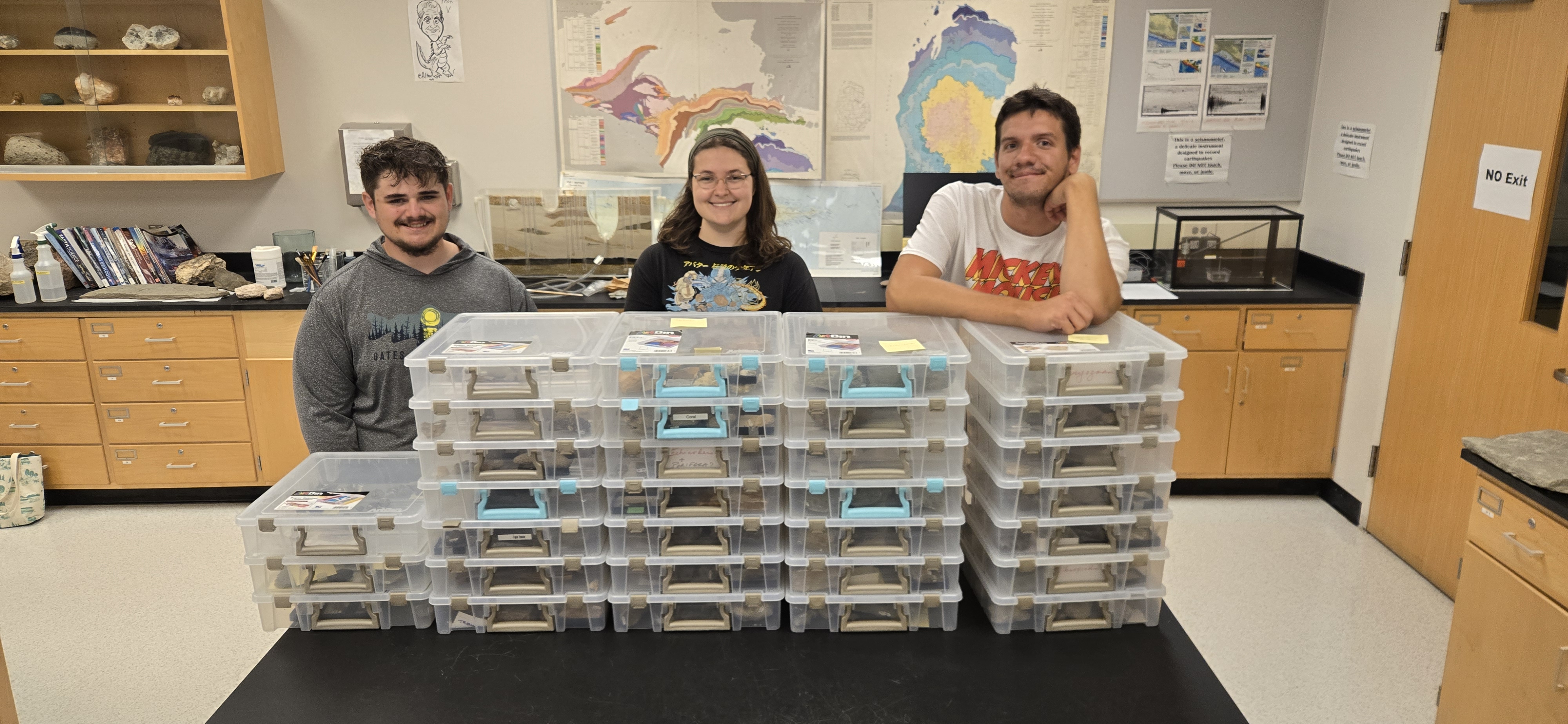
Pictured above: Students involved in cataloging the collection. Left to right: Cody Bennett, Ginny Stiles and Paul Kuchnicki.
Sorting Out the Mystery
How did those fossils come to be at GRCC? Tari and John are still digging for answers.
“Charles moved to California in the 1910s and started divesting his specimens to big museums and universities around the world,” professor VanRegenmorter said. “GRCC (then GRJC) was started in 1914. Even though we can’t figure out how or who, someone must have had a connection to Charles. As a result, we ended up with this incredible Sternberg collection that includes plants, fish, turtles, dinosaurs, mosasaurs, birds and invertebrates. Some of them, such as the ichthyosaur jaw, are quite impressive. Other specimens have probably been collected by professors over time and donated to the school.”
Regardless of how the fossils ended up at GRCC, Tari is grateful to John for organizing and cataloging the collection.
“John invested hundreds of hours of personal time and used his relationship capital with experts around the world to figure out what we have,” professor Mattox said. “He also got students involved in sorting and cataloging the collection. Now it’s all organized and labeled, and it’s a wonderful teaching resource.”
Inspiring Students Through Hands-On Exploration
Tari says that working on this collection is just one of the many ways that John inspires students.
“John’s greatest strength is his enthusiasm and love for the science,” professor Mattox said. “His excitement, combined with his connections, opens up so many opportunities for our students to get hands-on experience.”
John says that he wants to pay forward the opportunities he received as a young student.
“During high school, I started volunteering at the Denver Museum,” professor VanRegenmorter said. “They took me out and let me do field paleontology, and I was hooked. To put your hands on something, rather than to read about it, is incredible. Being able to do that for my students is one of my main goals. I want them to have the same amazing experiences I had. I also want them to decide if they love it enough to spend weeks in the desert, baking in the sun!”
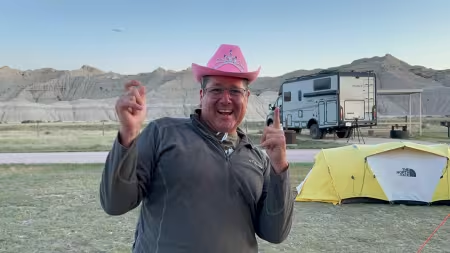
John just returned from a trip to Nebraska, where he collaborated with Dr. Cory Redman of Grand Rapids Public Museum to collect fossil samples that will be compared to a data set from Paraguay. Students often accompany him on his summer trips, and this one was no exception. In addition, he now has additional opportunities for students to help sift through and catalog what was brought back from Nebraska.
“Connecting with fossils links us to the past,” professor VanRegenmorter said. “When students touch fossils, the light bulb goes on. Expressions of ‘It’s so cool to see that’ make my day! It’s why I do what I do.”
Visit the Pre-Geology A.A. web page to learn more about this program and research opportunities.
This article was reported by Julie Hordyk.